Anne-Renée Hotte
Les rencontres ne savent pas qu’elles ont lieu
09.11–10.24.2026
Current

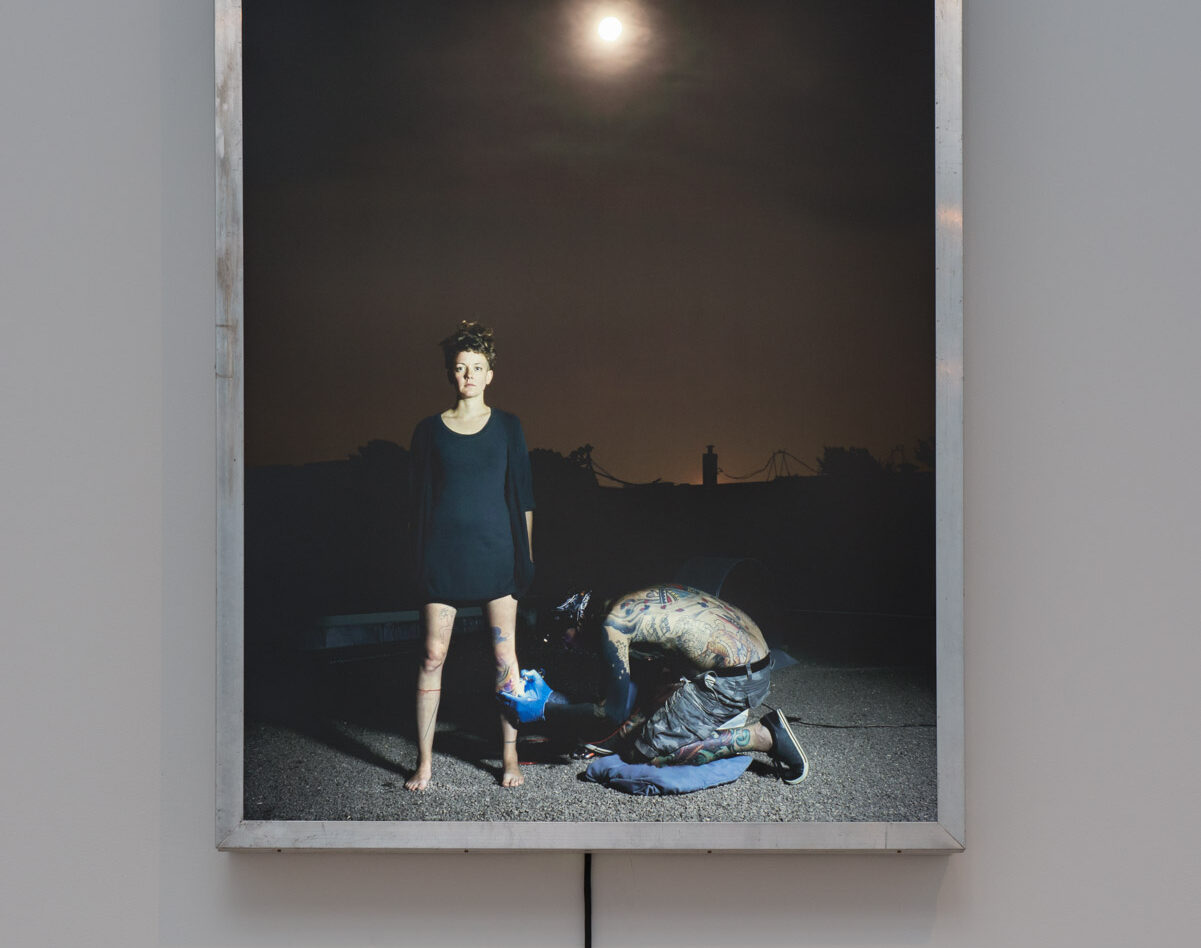
Michelle Lacombe, Moon (April 15, 2014).
Artist
Michelle Lacombe
For almost ten years, Michelle Lacombe has developed a series of projects that are specifically based in body art. Through various body modifications such as tattoos and scarification, she questions representations of white women, as well as other archetypes linked to female gender, through historical or cultural perspectives. Recently, Lacombe has focused on creating work that extends the presentation of her performances into an exhibition context. Beyond a mere presentation of performance documentation, Lacombe has created a coherent whole that is both self-contained and poetic, and which forms the core of her exhibition, Of all the Watery Bodies, I Only Know My Own.
For CLARK, Lacombe has created a series of works and interventions based on a yearlong performance she concluded in 2014. At each full moon[1], the artist revealed the fluctuating volume of blood in her body by marking a line around each of her legs[2] with an inkless tattoo. This repetitive action eventually scarred the artist’s skin, much like tides sculpt the landscape. In the gallery, a portrait of the artist, mounted in a light box, stands as a document of this action. Here, Lacombe is seen standing under the glowing moon while a tattoo artist traces a line around her leg for the thirteenth time, completing the final cycle of this full moon project. The image distances itself from other, more esoteric representations of women and the moon, which are found in abundance online. Far from conjuring ideas of fertility or seduction, this mise en scène shows the artist as a dominant force, in full ownership of her body. Her gaze meets ours, inviting us to take part in this experience.
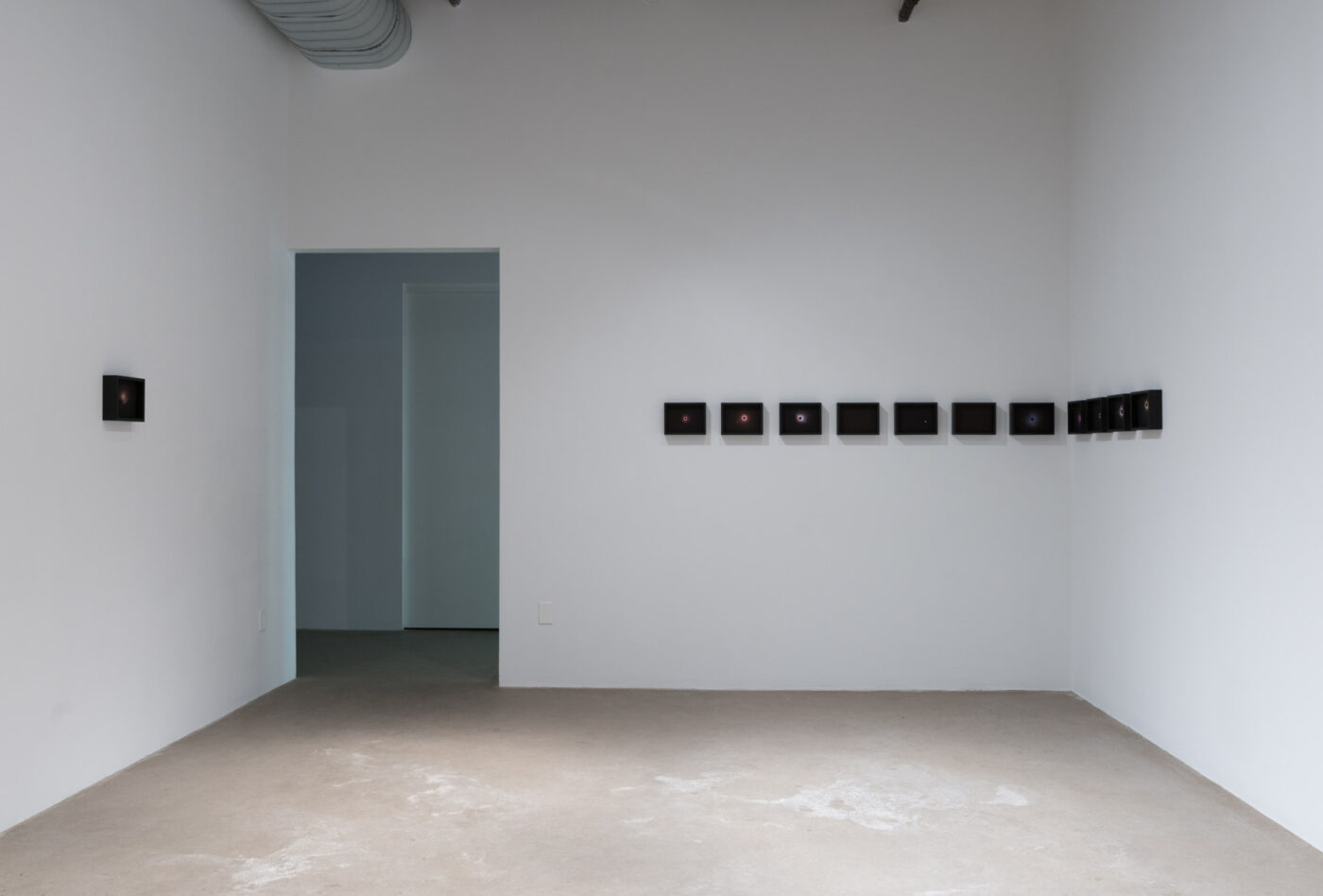
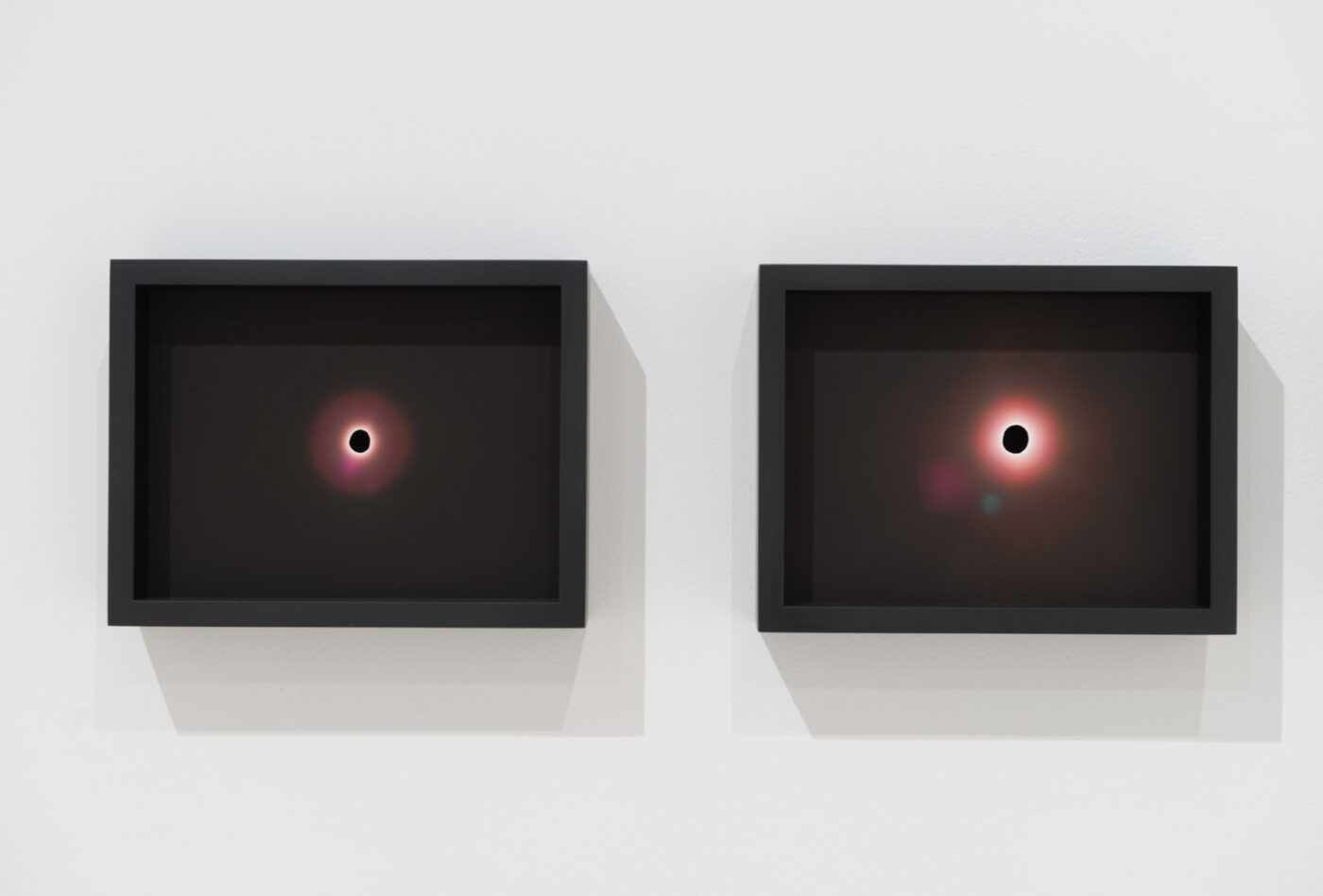
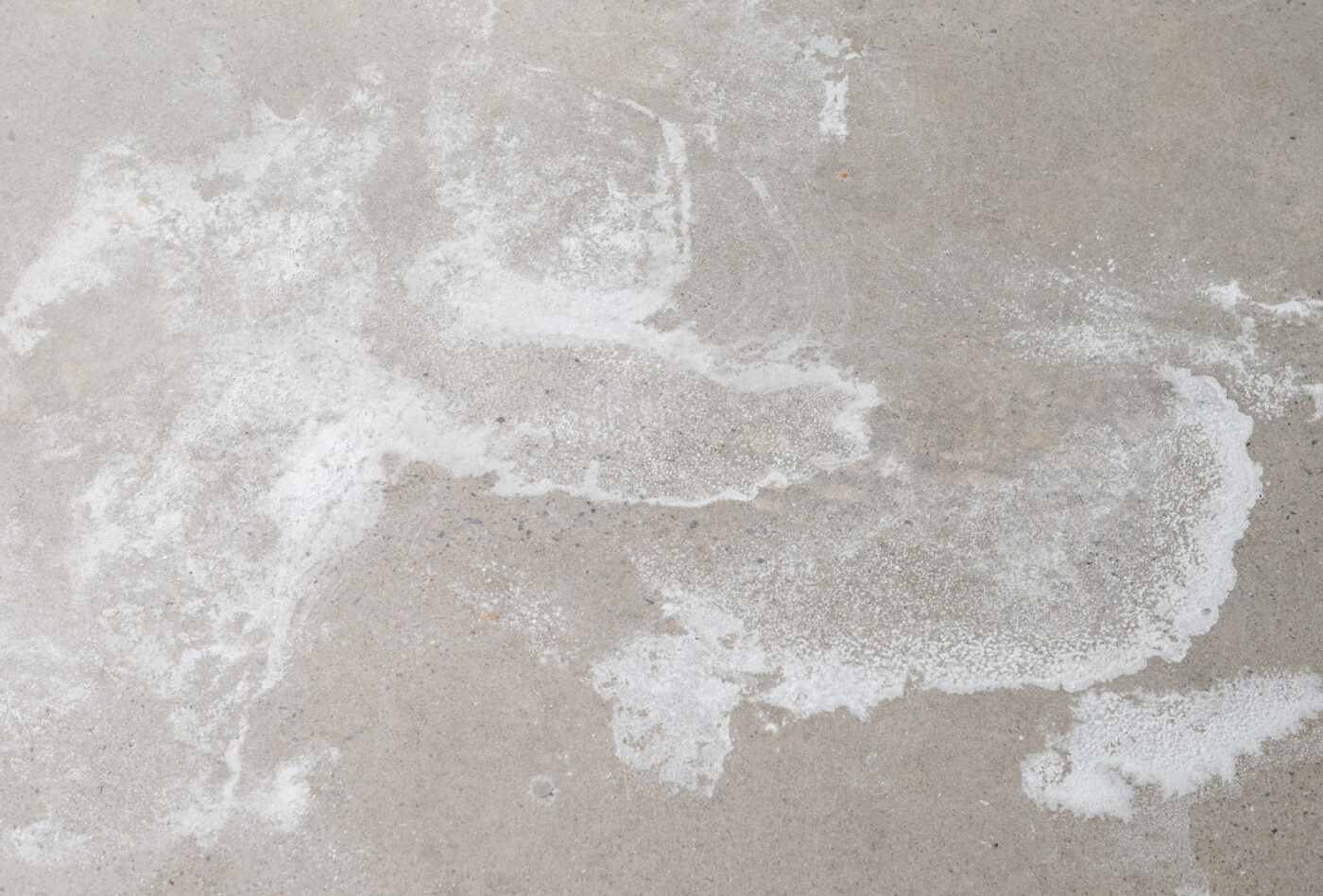
This self-portrait is accompanied by twelve photographs of the moon, the silent witness to each of her actions. To further engage her body with these images, the artist has cut out each of the moons. Elsewhere, a drawing made by pouring three litres of salt water on the floor refers to the fluctuating volume of blood in the artist’s body, and to the actions carried out to measure it. Through successive pouring and evaporation, a crystallized pattern remains, creating a series of sinuous forms resembling landmasses viewed from the sky. The whole remains rather minimal, but allows the artist to express one work via different actions at different times. In fact, the exhibition begins with the portrait that concluded the annual cycle, followed by the dozen images of the moon on which the artist has intervened as a testament to her experience, and finally, the in situ drawing that leaves a tangible trace of the artist’s passage through this space.
– Manon Tourigny / translation : Jo-Anne Balcaen
[1] The moon’s cycle corresponds to 28 days, the same number of days used to calculate a woman’s menstrual cycle. The moon is therefore intrinsically linked to representations of women and fertility, but also to the changes and modifications in her body.
[2] The artist gauged the height of each line by standing in a pool of water containing a quantity of liquid equivalent to the body’s volume of blood.
CRÉDIT PHOTO: PAUL LITHERLAND


CRÉDIT PHOTO: PAUL LITHERLAND

CRÉDIT PHOTO: PAUL LITHERLAND
CRÉDIT PHOTO: PAUL LITHERLAND

CRÉDIT PHOTO: PAUL LITHERLAND
CRÉDIT PHOTO: PAUL LITHERLAND
CRÉDIT PHOTO: PAUL LITHERLAND
A crowdfunding campaign for emerging artists.
