Object: Expo à CLARK
Date: September 21, 2026, 4:14PM
From: Camille-Zoé Valcourt-Synnott <[email protected]>
To: Lou-Anne Bourdeau <[email protected]>
Hi!
I hope you’re surviving your hectic day 🙂
I’m hoping that my exhibition at CLARK won’t be adding too much stress to your plate! I’ll need to head back to Montreal this Thursday afternoon to finish my meetings with the team. I’ll be available in the morning if anything comes up!
Also, the installation period runs from October 27 to November 5. I don’t have the exact installation dates yet, but I expect I’ll need about 2 to 4 days during that period.
I’ve accumulated some vacation time (25 hours, I think), so I’ll confirm everything once I know the exact dates. I was planning to use my vacation hours so there wouldn’t be any changes to my pay.
As for the exhibition itself, it runs from November 5 to December 19. The opening is on the evening of November 5, starting at 6 p.m.
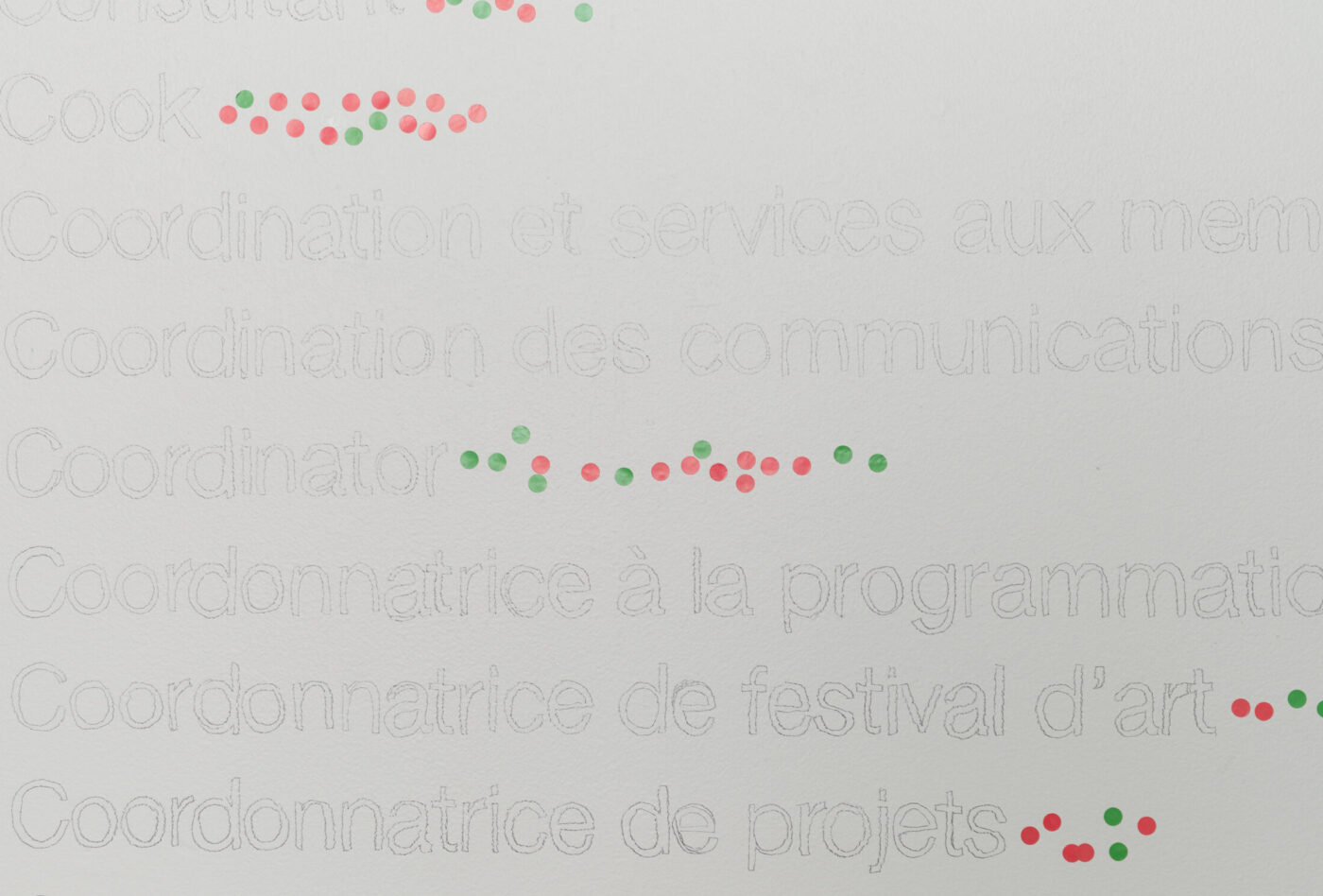
As I’ve mentioned before, part of my project involves filling in for each member of the CLARK team for one day a week, on a rotating basis, so that everyone gets a day off during my exhibition. So far, we’ve discussed Fridays as a good option for these substitutions/performances.
During the exhibition, I would therefore work my hours at La Maison over four days, from Monday to Thursday.
I hope that works for you! Let me know if you’d like to chat about it in person or over the phone.
Have a great rest of your day!
Camille-Zoé Valcourt-Synnott
elle / she – her
Administratrice et gestionnaire de galerie / Gallery Manager and Administrator
—
I received this email when I was in the middle of installing a show with a curator and an artist. I know how much administrative, technical, and creative work goes into presenting a professional exhibition—both before and after it opens—because I go through it every couple of months. I fully understand what Camille will have to do ahead of her own show, and how it will conflict with her full-time job. She says she hopes her email won’t cause any additional stress for me. But it does.
I’m glad she told me ahead of time, but I already feel overwhelmed. Her request comes on top of our own installation work, fewer hours with staff who’ve gone back to school, a backlog of files I need to deal with, and an overflowing inbox. September is always a busy month with our AGM, the changeover of exhibitions, our activities report, the start of the school year, and everything else. I’m getting anxious because I can’t see myself saying no to her, but I also don’t know how I’ll manage the extra workload this will trigger. I set her email aside.
The next day, feeling more level-headed, I’m more open to her request, but I also see the irony in it: Camille is asking for time off from her job at La Maison des artistes visuels francophones so she can do a performance at Centre CLARK that involves replacing each employee for a day so they can have some time off.
This clever hall of mirrors neatly exposes the hidden side of exhibition making. A show doesn’t go up on its own. The work needs be considered, of course, but so does the layout, the installation, the promotion, the public outreach, the event coordination, and countless other details. This requires a logistical sequence involving many people with various skills; the subtle mechanisms behind any seamless operation, all in the name of showcasing the artist’s work. Will this sudden wrench in the works jeopardize our activities? Who will cover for Camille while she’s covering for CLARK?
I reread her request: the dates, the 25 hours of accrued vacation time, the uninterrupted pay … Underneath that formal vacation request is someone who’s calculating their hours to make sure they can cover their expenses. Within those two lines, Camille’s vulnerability as an artist is laid bare: even though she’s highlighting the invisible work of others—the artists who need day-jobs to pay for their art practice, and the cultural workers who toil in the background of art institutions—she herself must perform invisible tasks so that she can afford to show her work.
In the end, I accepted her request for time off, and simply asked her to confirm the days she would be absent.
– Lou-Anne Bourdeau, director of La Maison des artistes visuels francophones in Winnipeg, Manitoba
Translated by Jo-Anne Balcaen
—
Lou-Anne Bourdeau (she/her) is a cultural worker, curator, and textile artist who has worked in both Quebec and Manitoba. She has been the Executive Director of La Maison des artistes visuels francophones since 2024. She studied textiles at the Maison des métiers d’art de Québec and art history at Université Laval in Quebec City. Her curatorial projects include Incarnation (2022) and COMME À LA (M)AISON (2026). Lou-Anne is actively involved in various initiatives and serves on several boards of directors and committees, working to support Francophone artistic practices in official-language minority communities across Canada.
—
The artist would like to thank the following people:
The Centre CLARK team: Joséphine, Hubert, Guillaume, Corine, Melina, and Sayaka
The Atelier CLARK team: Natacha, Greg, Rachel, Joëlle, and Rían
And Lou-Anne Bourdeau, Louis-Charles Dionne, Caroline Savaria (L’imprimerie centre d’artistes), Elise Boudreau Graham and Hugo Dufour (Céline Bureau), Laura Bayet, Thérèse Chabot, Emma Allain, Peter Counter, Justine Skahan, Selena Phillips-Boyle, Laurie Magnan, Jo-Anne Balcaen, and Joshua Schwebel.