Anne-Renée Hotte
Les rencontres ne savent pas qu’elles ont lieu
09.11–10.24.2026
Current
Artist
Nicolas Baier & Emmanuel Galland (Commis)
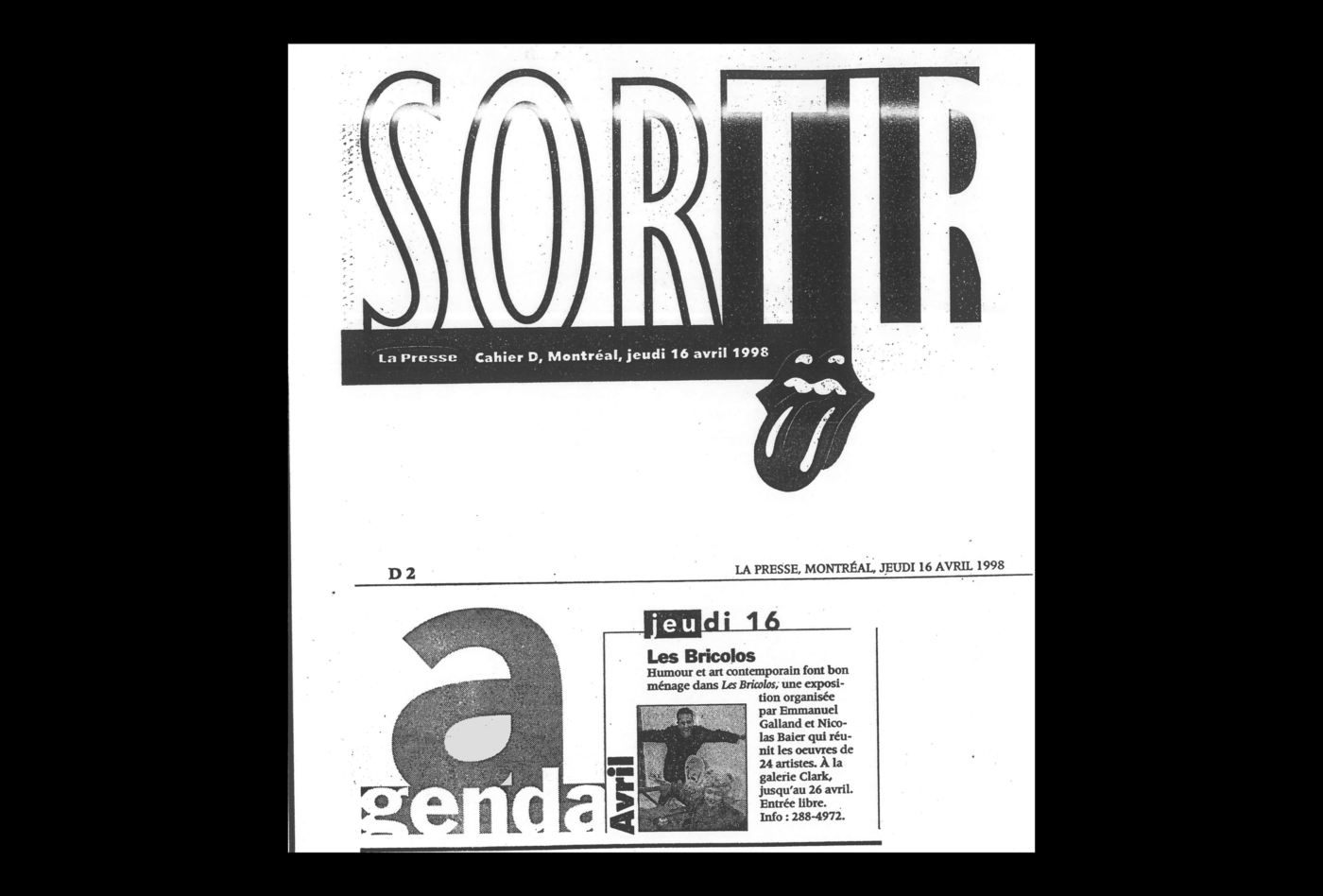
Curators : Nicolas Baier and Emmanuel Galland
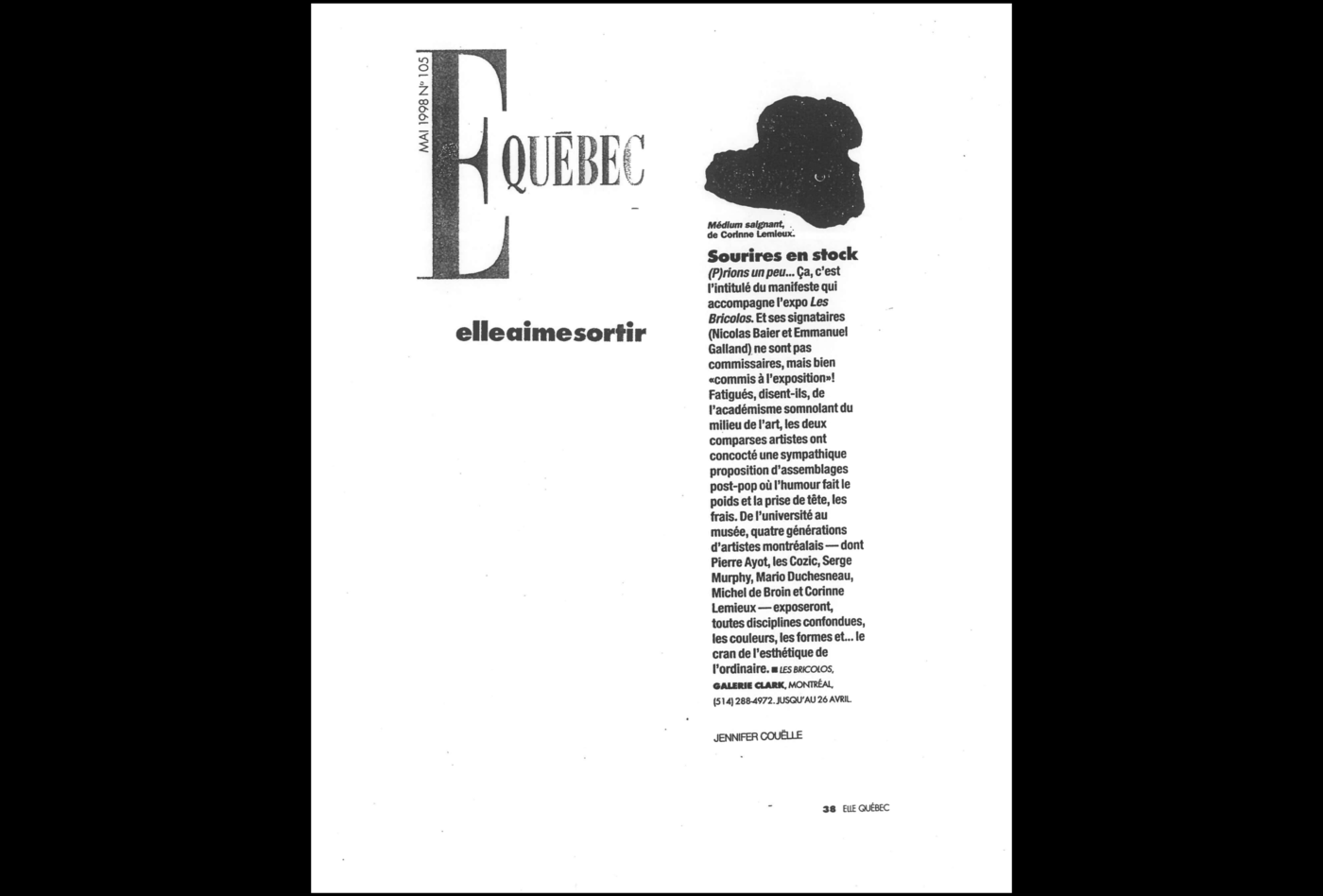
LET’S PRAY (OR PLAY) A LITTLE
–The clown says:
“I am not a philosopher”
–The Tinkerer proclaims:
“I am not a gadget-maker”
–The curator predicts:
“and the audience loosened up”
Laughter: so little of it emerges from what one sees in galleries during those Saturday gallery-hopping rounds—that community of taste functioning like a centrifuge. How can one get a grip on the network and its steady stream of exhibitions—each taking a turn at the sluggish crank? How do we break free from the “goo” (as Catherine Millet put it)? Let’s shake up the mix of administrative contingencies and the expected conventions of hanging, juxtaposition, and the “aura” of artworks.
It is high time to get down to business: let’s bring out our rifflers, our vices, our shells, our needles, our clamps, our fountain pens, our hooks, our test tubes, our food mills, our haversacks, our floppy disks, our Zip drives, our work lights, our polishers, our biscuit joiners, our *fougasse* breads, our small hammers, and our rock-paper-scissors. Let’s roll up our sleeves. Let’s fly off the handle.
“Next week I have to start cutting hay. I sold my oxen. I found them too lazy, and I’m keeping an eye out for a chance to buy horses. I built myself a shed to house my wagon, my sleighs, and my disk harrow, as well as my other tools.” Fernand Bellehumeur, *Partir*, Stanké, p. 148, 1996
We lay claim to a practice that plays with cunning—a practice made up of a vast gathering of stories, a multiplicity of windows, the organization of a hodgepodge, a joyful cannibalism of ideas, and a makeshift art that domesticates the domestic, using the fitting for the content. Real life always catches up with us in what it shares with the everyday, the trivial, the isolated, the inconsequential. Let us trace a curve alongside the spoken word. Let us restore dignity to the makeshift, the little thing, the gadget, the worthless, the ready-to-transcend/transubstantiate. We want to believe that there will no longer be issues of color, form, or style.
Let us shake up our relationship with technology and the learning of it—that unhealthy unease regarding the “up-to-date,” that nebula that petrifies the melancholic and the nostalgic. To hell with the old fogies. Let us stand tall, pointing the way and full of optimism, heart in the work, hand in the basket. Thus, assembly-line work, handcrafting, and machine tools will turn us into decision-makers: let us have faith, acknowledge the reality, and raise a glass! “Suddenly, I thought back to the tool with a bunch of grapes engraved on the handle. It was as if Mr. Martinelli had used it to make toothpicks. They say men don’t use ten percent of their brain’s potential. And the same goes for their machines.” Pierre Foglia, *La quincaillerie*, *La Presse*, p. A.5, Saturday, February 28, 1998
Do we really want to keep acknowledging what we already know, what we have already seen or learned? We feel the desire and the urgency to pick up where things were left off (the supposed “end of art” / “death of painting”), as well as the responsibility to avoid falling into routine or repetition. Let us take the back roads; let us keep searching for the outposts and forward positions where no one has yet set foot. Where are our brothers—those revelers?
“What a reveler!” Joseph said to himself, using a popular expression common in the workshops. Balzac
Where have they gone—the female spies, the embellishers, the recruiters, the open-armed hosts, the gullible souls, the relayers of gossip, the gatherers, the bronze-casters, the *conquis-tadors*, the enduring coronations, the disruptors of the status quo, the graceful circles, the self-adorning criers, the hermit crabs, the uncouth bears, the emperors and the borrowers, the mercenaries, the hired guns, the free Amazons, the colorblind, the hairy divas, the Medusa statues, the parachuting “squirrels” and the snuggling “hedgehogs” (as Anne Cauquelin puts it), the coup-plotters who never put things off until tomorrow, the prompt payers, the collectors, the Job’s tears and the joy in the eyes of pipe carvers, the outlaws, the utopias of utopians, the trackers, the clairvoyant editorialists, the Joes and their Janes, the whittlers and the eccentric visionaries?
“You have seen an ordinary event / An event such as occurs every day / And yet, we beg you, / Beneath the familiar, discover the unusual, / Beneath the everyday, detect the inexplicable, / May everything deemed habitual unsettle you.” Bertolt Brecht
We’ve reached the end of our rope, and we have no use for fence-sitters, weepers, loudmouths, holy wafers, rearview mirrors, prudes, banks, one-armed men, tombstones, sticklers for propriety, patrollers, the uptight, the incurably ill, tomatoes, noodles, bingo nuts, the outhouse boss, degrees without value or purpose, posthumous recognition, standard TV, the tyranny of the “next generation,” or the precariousness of the bohemian life. To the pillory with them!
Let us swear an oath: yes to the pleasure found in doing and in seeing.
Put a stop to the gloom! Make yourself known!
Nicolas Baier & Emmanuel Galland
Curators of the *Les Bricolos* exhibition.
“If there is a function specific to art, it must manifest itself in what distinguishes it from everyday life…” Arthur Danto, *The Transfiguration of the Commonplace*, p. 65, Le Seuil, Collection Poétique, 1989.
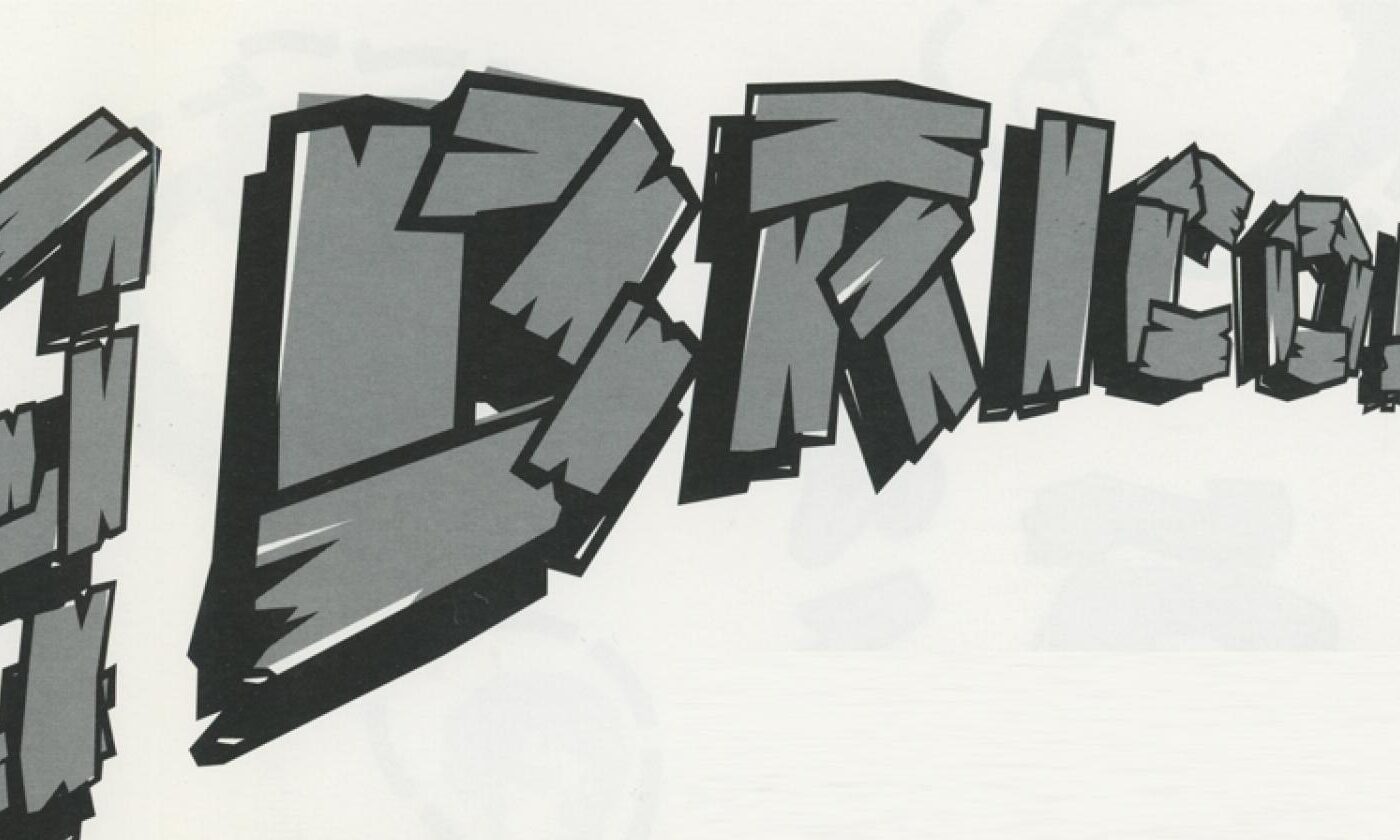
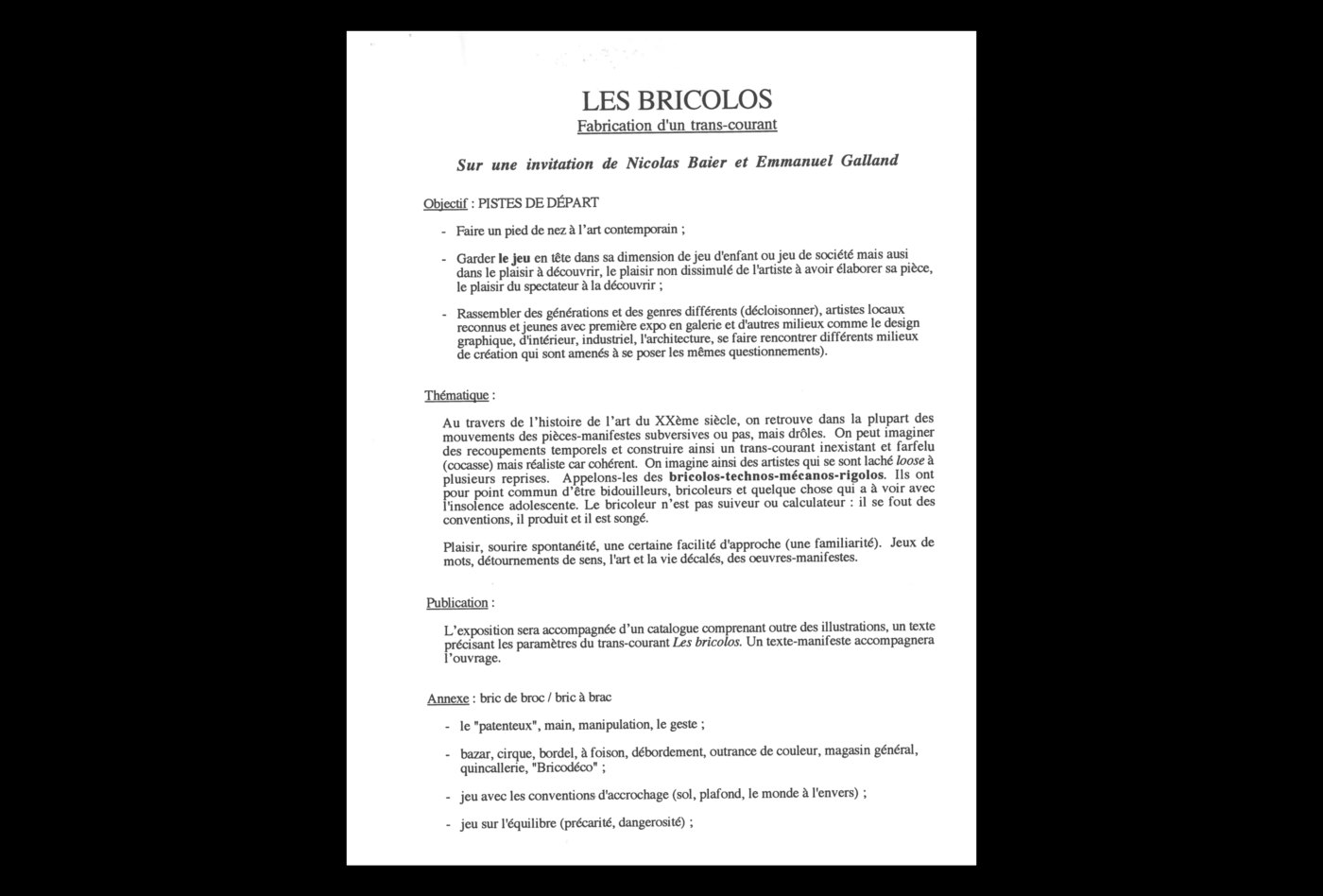
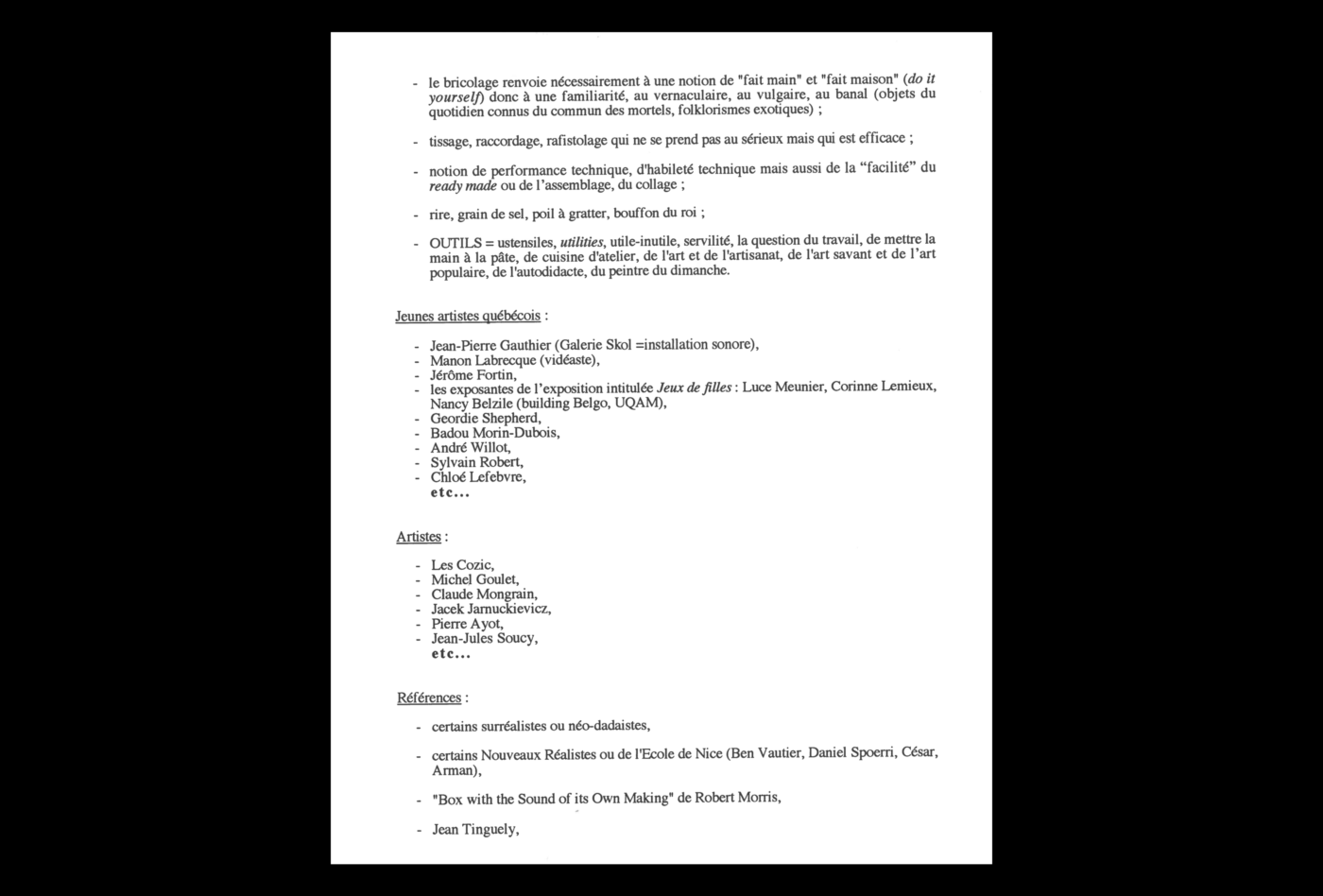
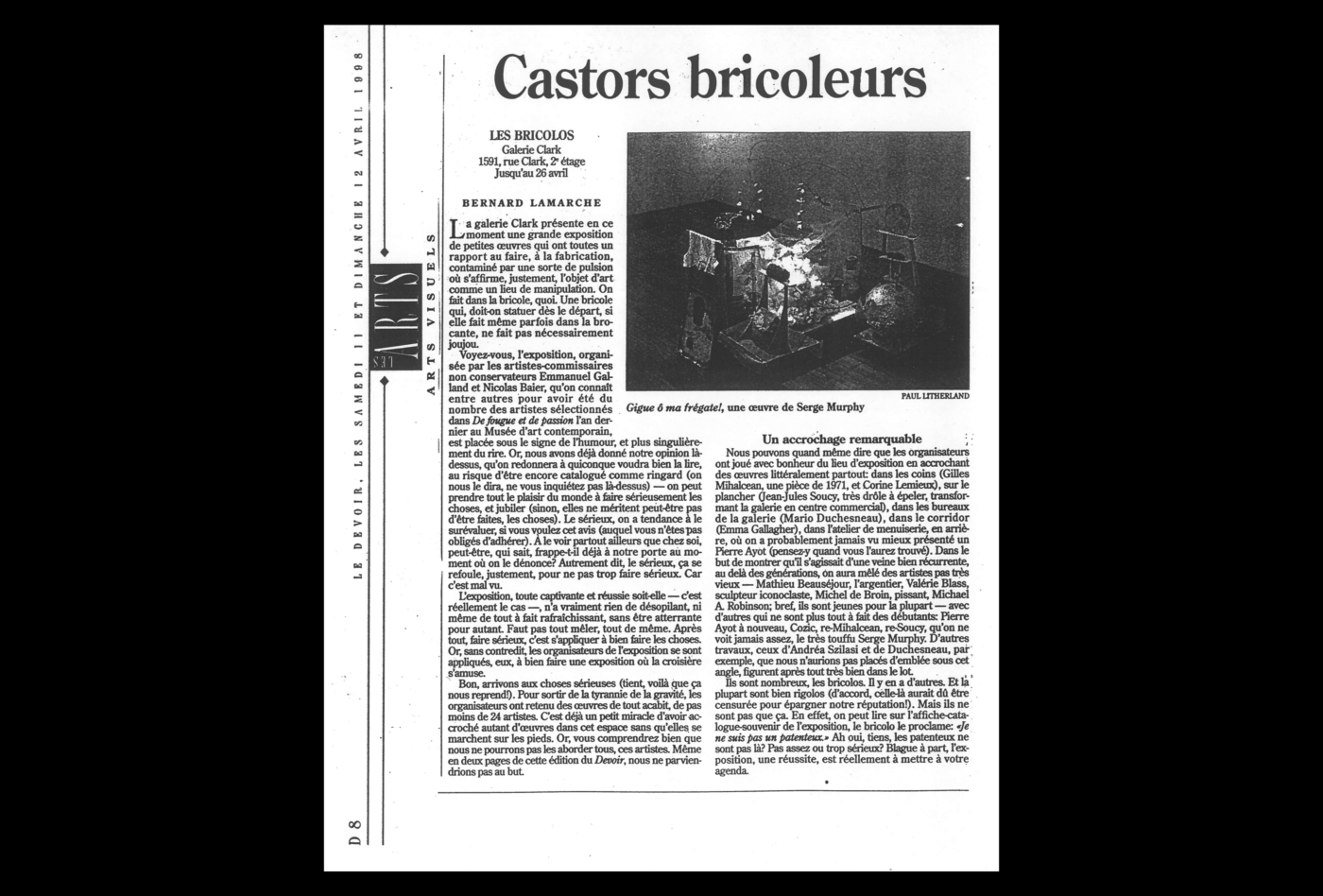
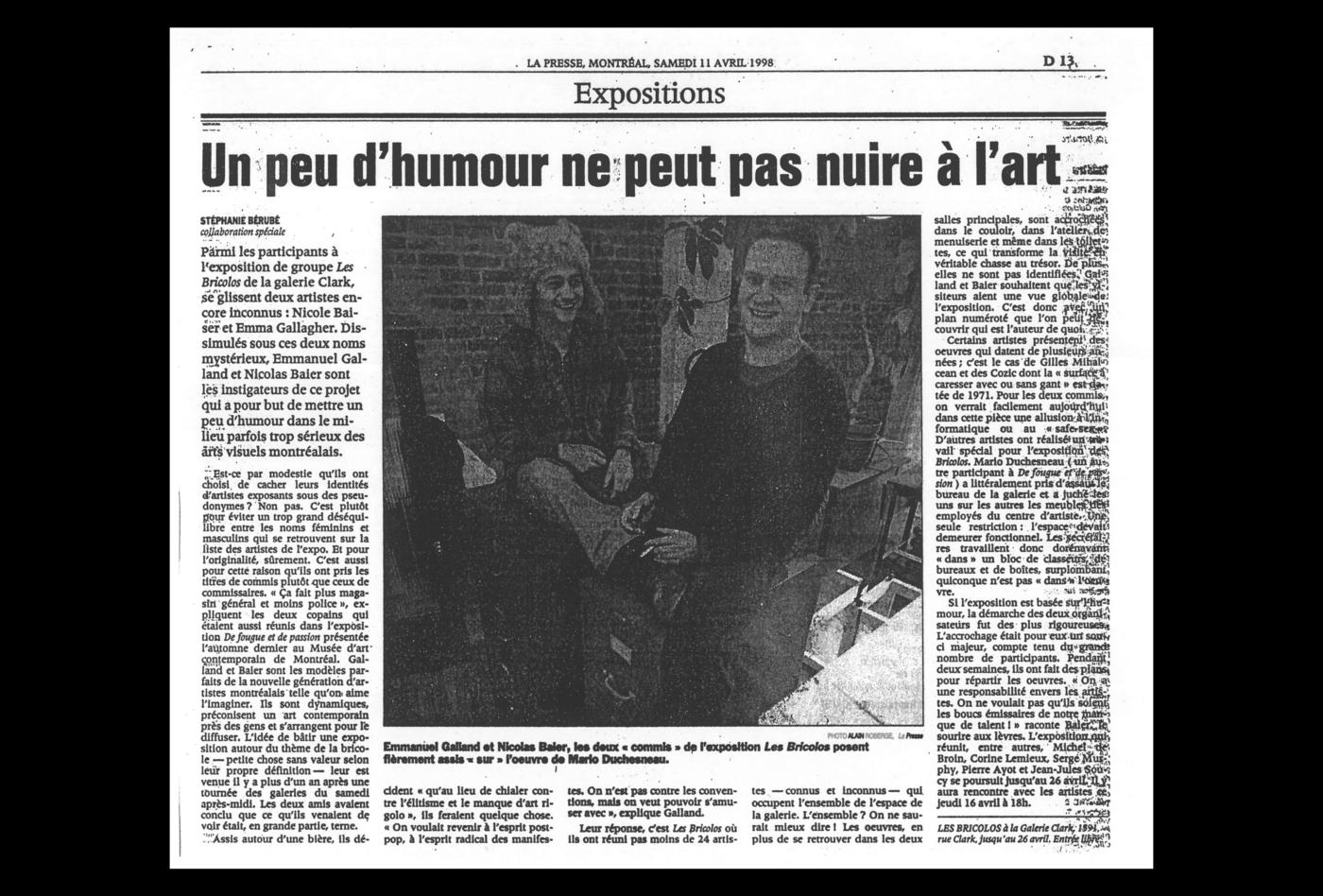
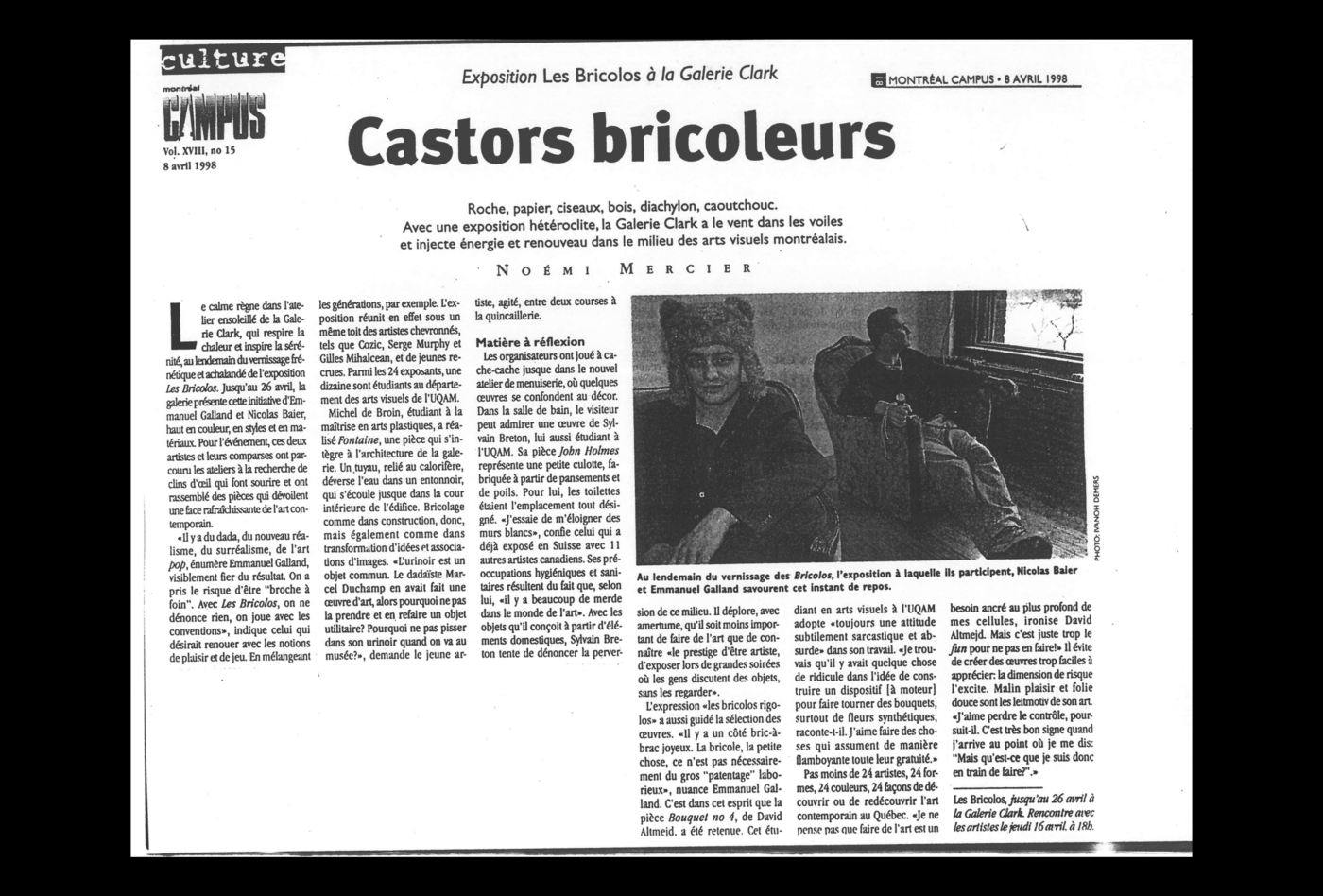
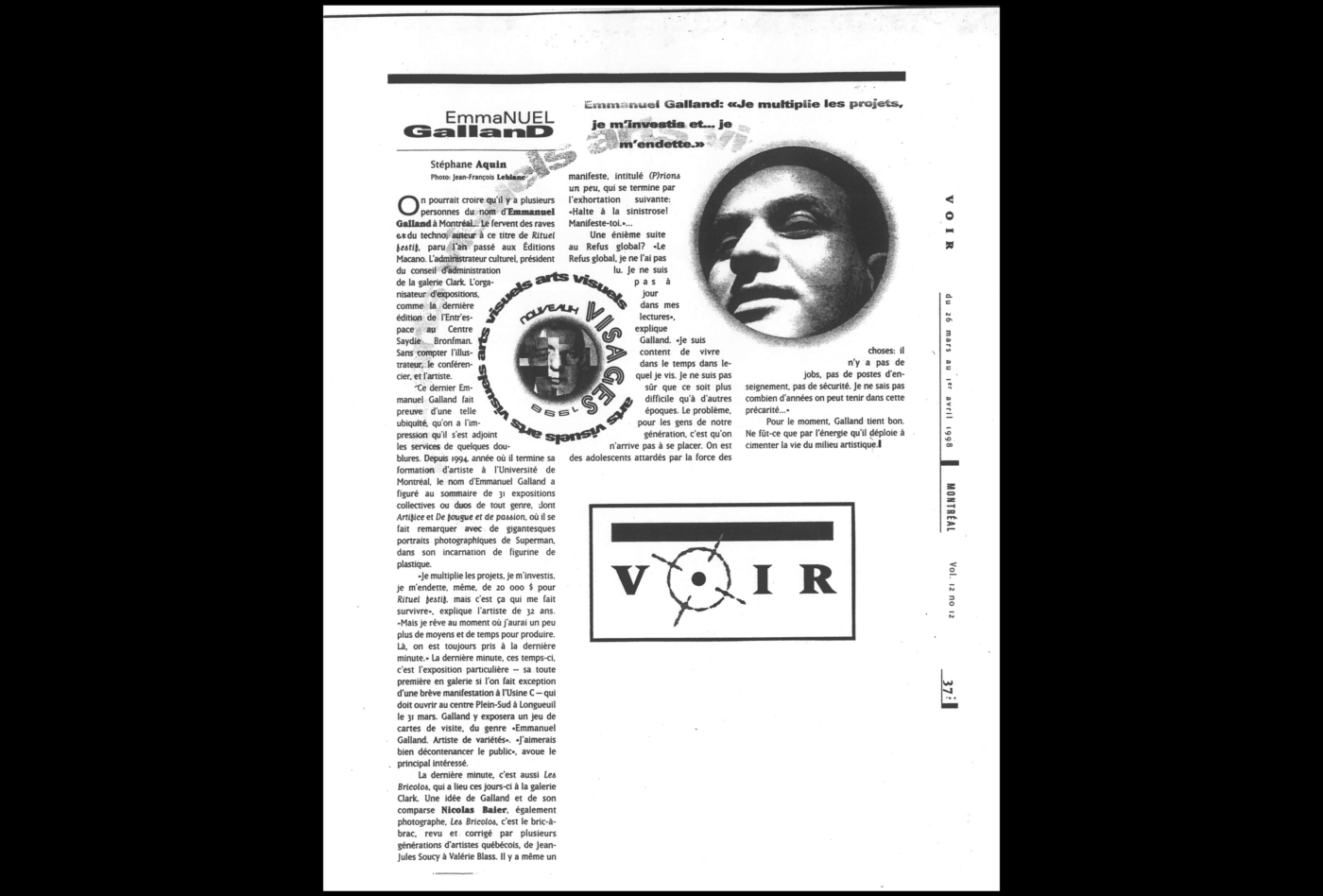
An art movement—whether stemming from shared intentions that adopt a specific aesthetic stance or linked to an external desire for historical synthesis—encompasses a worldview and sometimes even a vision of the universe. The elliptical forms of the Baroque era, for instance, influenced the astronomical concepts of their time. The exhibition *Les Bricolos* thus appears to be the work of a movement that adopted a manifesto, with its core research focused on an aesthetic of the ordinary and a playful subversion of everyday reference points. In truth, it is a mock movement—a Dada-esque gesture in which organizers Nicolas Baier and Emmanuel Galland (artists by trade) chose to fill the roles of “clerks” rather than exhibition curators. Disappointed by a standard gallery tour a year ago, they decided to take a chance and challenge—through mimicry—certain traditions, including the convention of the thematic exhibition. “Playing with conventions”—or so they say. *Les Bricolos* was originally the title of a painting intended to serve as a touchstone—a leitmotif—for the selected works and for the playful way they engage with the familiar, often domestic worlds that serve as their points of reference. Engaging with the event requires embarking on a multi-layered journey and likely accepting a certain sense of drifting. Consider the ambitious scope of the program: some twenty artists spanning multiple generations, presenting works from the recent or not-so-recent past (some created specifically for the exhibition). These works take over not only the main gallery space but also adjacent areas and functional infrastructure: the legendary wood workshop (inaugurated for the occasion) and the corridor leading to it, as well as the coordinator’s offices, the restrooms, and even the heating system. The aim is to examine functional, mundane, and familiar objects as they are surrendered to the realm of fiction. It is a poetry of anachronism and imperfection, where the splits, flaws, and breaches introduced into the everyday lives these ordinary forms inhabit give rise to errors of presentation, representation, and mimesis.
The compulsion to make
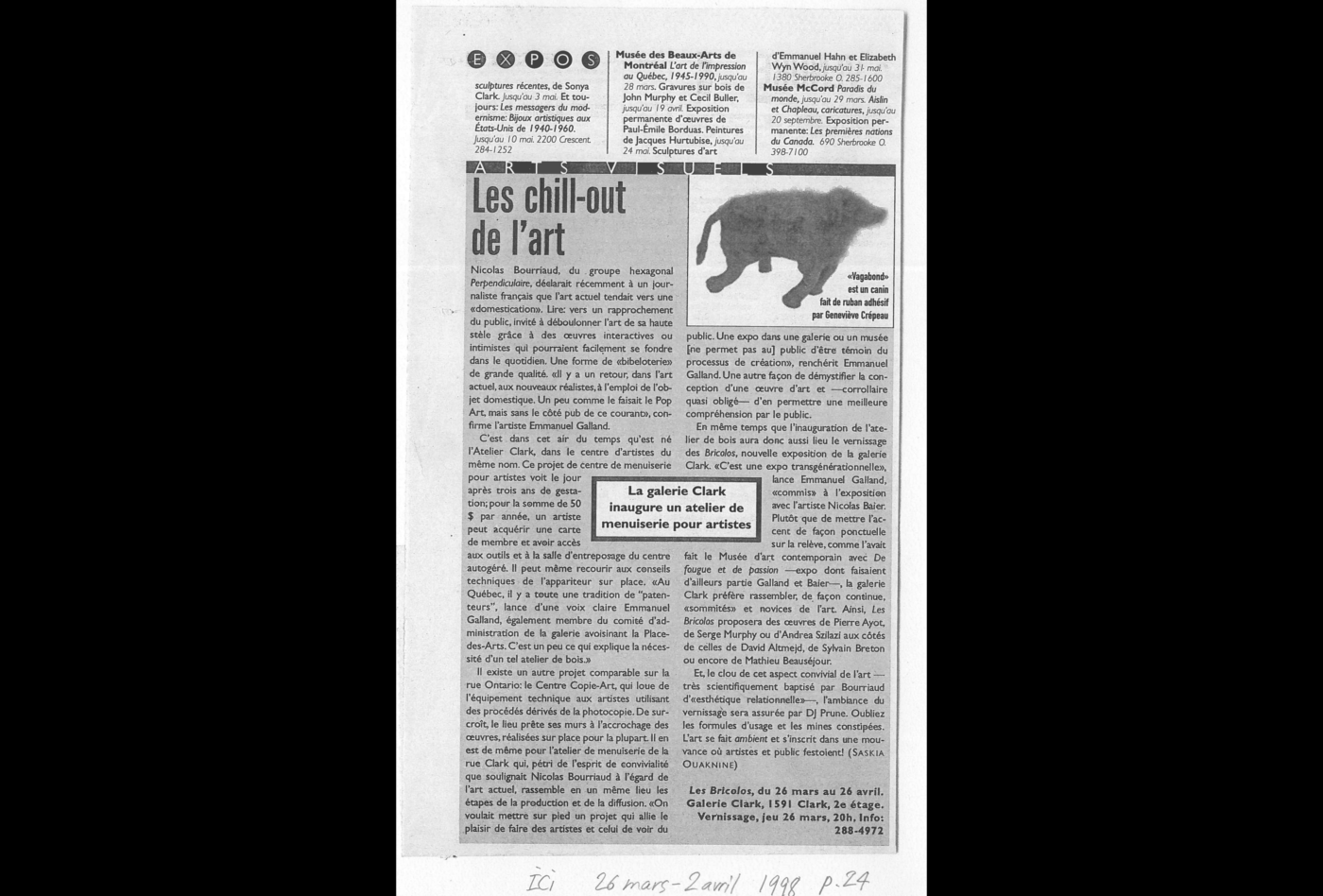
Shifting from the functional to the fictional also entails grappling with the haunting compulsion to *make*. It means viewing ordinary manual labor not only as part of the artistic process but also as a model for representation. Andrea Szilasi—known for her interwoven photographs—presents new dualities. Two photographs, *Inhale* and *Exhale*, reveal a breathing rhythm: first through the back-and-forth motion suggested by the temporality inherent in the images, but also through the cadence of the weave embedded within the picture and the oscillation of words affixed to the depicted human body. Laurent Roberge, known for his work with fiber and paper, uses magazines to engage indirectly with photographic imagery. He cuts them into tiny, stacked squares, patiently building massive, colorful, layered volumes; their surfaces evoke needlework, while their tiered structure recalls the fragility of a house of cards. Highlighting this same material precariousness—yet using an adhesive binder where Roberge does not—Geneviève Crépeau presents a sculptural canine figure with a precarious stance, bearing the name *Vagabond*. Illusorily translucent and equally unstable, this form—perpetually leaning—is swaddled in adhesive tape, as if to keep its limbs from falling off. Using a material that also relies on an adhesive surface, Sylvain Breton fashions a jockstrap named *John Holmes* out of numerous medical adhesive strips. It is interesting to observe the duality between protection and bandaging embodied by this object, as well as the questions it raises regarding our notions of taste (good or bad) and disgust. On display in the restrooms.
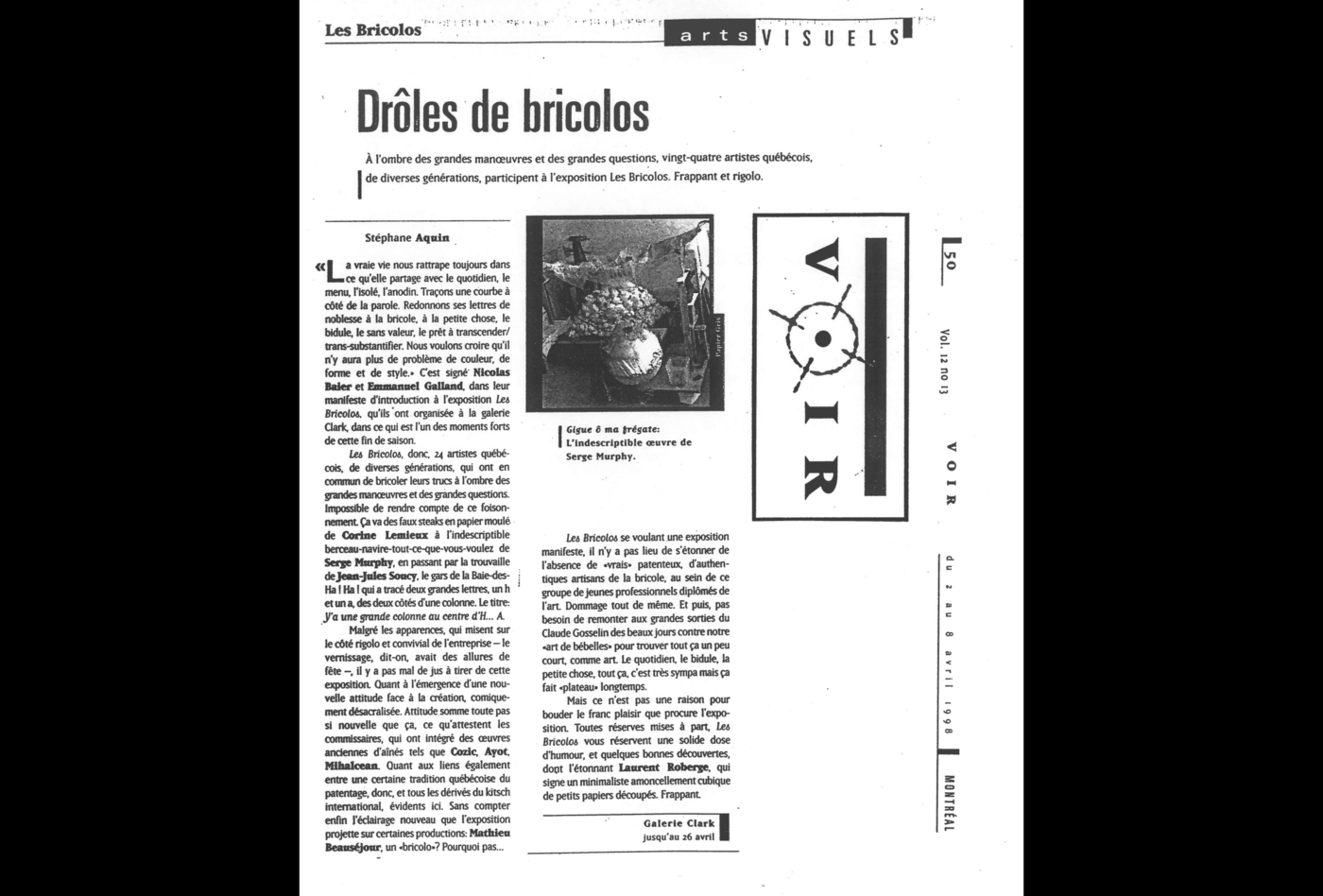
Gilles Mihalcean invites us to revisit *L’anxiété* (Anxiety), a work from the 1970s featuring multiple, molecular-like knots that bind small spheres to safety pins. The work’s exclamatory nature is matched only by the aptness of its title. We are compelled to recognize that, beyond the compulsion to create, what is staged here is a compulsion to exist. With *Gigue Ô Ma frégate*, Serge Murphy pushes the boundaries of installation art even further, incorporating materials that border on refuse—materials otherwise destined for inevitable oblivion. An alchemist of humble, unpretentious substances (torn paper, reclaimed wood, wire, polystyrene foam), Murphy lifts them from the everyday and restores them to a state of exuberance.
Pagan stagings as interludes of devotion to the mundane
*Surface à caresser* (Surface to Caress), a 1971 work by Cozic, presents a tactile plane that bypasses actual connection in two ways: through the use of a glove and a covering surface. We are invited to experience the paradox of the glove and savor the sensuality of a glowing red plush surface; from afar, it promises a painterly quality, yet upon contact—despite its cozy feel—it reveals itself to be a flat object devoid of depth. Michael A. Robinson’s *Left-overs*—debased, pagan versions of forms—resemble votive figures that might have been popped into a microwave to warm them up. These conveniently sized Buddhas also evoke the shrunken heads of Voodoo rituals or the cheap ceramics found in “everything-for-a-dollar” shops. They have a curious way of embedding the comical right into the spiritual. With *Disposition en plates-formes* (Platform Arrangement), Mario Duchesneau proposes an “altar of leveling” for the gallery office furnishings. As if tidying up or reorganizing workplace ergonomics, the project involves raising all the furniture to a height of about five feet—and placing the coordinator on a platform, too. The “behind-the-scenes” world finally steps into the spotlight. Three works create a path leading to the other side of the gallery, toward the workshops. They are the creations of Nicole Baiser, Emma Gallaher, and Daniel Langevin. These works stand as portraits—idealized effigies or archetypes of the inveterate tinkerer—yet they also embody a certain irony. The first portrait lends its plural name to the exhibition. Combining photography, collage, and various pigments, *Les Bricolos* (The Tinkerers) depicts a scenario where things have gone awry—where invention has been taken too far. The second portrait, *Le peintre* (The Painter), presents an image of a painter that looks as though it were torn from the pages of *Popular Mechanics*; he stakes out a spot in an unfinished corridor, surrounded by construction materials. It is a form of photographic statuary that shares the same workshop-and-artisan folklore found in Langevin’s *The Man Who Saw the Bear*. That latter photograph—which relies heavily on staging—shows the man at rest, appearing as a doubtful “Thinker.” Finally, alongside it stands Pierre Ayot’s *Plywood 4’ x 8’* (1979/1980): a soft, fabric-based surface—resembling a suspended quilt—screen-printed with a wood-grain texture. The object’s placement in the center of the carpentry workshop creates a delightful paradox. This object, imitating wood, appears invalid and impossible—by virtue of its very presence and the aberrant relationship it maintains with a place where the actual thing serving as its reference is being worked upon.
Mechanisms and Interventions
David Altmejd’s *Bouquet No. 4* might easily pass for a weekend DIY project. Yet, he elegantly mounts his electrical cords on the wall—wrapped and arranged in a manner that is nonchalant, if not ostentatious—like a kind of graceful threat. At their ends bristle two motorized plastic bouquets, violently embracing in a clumsy, mismatched dance of speeds. Meanwhile, introducing a sort of mischievous disorder into the heating system, Michel de Broin bleeds the radiator to create a “Fountain” that flows all the way to the inner courtyard drain. This diversion of flow evokes both the habitual human need to urinate and the networked distribution of maple sap, while also calling to mind Duchamp’s urinal. Mathieu Beauséjour, known for his proliferating “viruses,” promises a performance—also Duchampian in spirit—titled *Déficit* (Deficit) for the opening, featuring our trusty banknotes. These bills—inescapable templates of everyday life—will serve literally as a standard of measurement during a head-shaving act. For the duration of the exhibition, an imprint on the wall (*Emprunte du surplus* / Borrowing the Surplus), bearing witness to this action, gives a less ephemeral form to this rectangular hairstyle. Paul Lacerte introduces us to a device titled *Chaise, électrique* (Chair, Electric), an example of furniture being electrified. A chair is subjected to a frenzied relationship with the power grid—so intense that it requires a release valve, a hatch that (in an ultimate paradox) needs an electrical impulse to spring into action. Finally, *Il y a une grosse colonne au centre d’H…A* (There Is a Big Column in the Center of H…A) is an intervention by Jean-Jules Soucy. It plays out an interaction between language and place, revealing the metaphorical virtues of literalness. The column at the center of the gallery thus plays its proper role in this confrontation—at once literal and figurative—between letters standing in for words and their strategic placement before the intent to signify.
Figurations: Narrating the Possible
Let us take the expression “a beautiful frame” literally. We are dealing with painting and the boundaries that define it. Pascal Grandmaison presents *Les opérateurs*, two large photographic reproductions of woven pieces—textile equivalents of paint-by-numbers—depicting outdoor scenes. Beyond the “beautiful frame,” the aim is to manipulate these boundaries and produce a reinterpretation—a new narrative—transforming them into moments that are both dual and deferred. In *Castor-mamelon*, Paul Litherland uses the hairy skin of one body to obscure that of another. Suspended on a wall is a fur coat with an opening in the back, revealing a photograph of a male nipple through the gap. It is tempting—indeed inevitable—to conjure up erotic imagery: body parts represented by other elements. The work derives its power from this ambiguity and the underlying narrative potential. Luce Meunier places a patch of lawn on the floor—a “grass carpet” made entirely of paint. It is no longer a mere coating, but rather a sort of flattened volume from which spikes of paint emerge; the uneven density of this growth evokes a natural proliferation while simultaneously highlighting the material’s synthetic, plastic nature.
Corine Lemieux’s *Médium saignant* (Rare-Cooked Medium) invites our eyes—and their appetite—to engage in a gaze that is insistent, if not provocative. A paper cast shaped like a steak bears a googly eye as its effigy. This object prompts reflection on the intimacy between how we appreciate objects and how we name them. It thus insinuates a disquieting realization: what I see and what looks back at me do not align with the words I might use to describe them. Also using paper—though as a mold—Valérie Blass presents a sculptural form that intrigues through its contradictions. At once lightweight yet made of concrete, *Nuage* (Cloud) represents exactly what its title suggests, yet possesses the heaviness of a cannonball—a form our imagination would prefer to be intangible, but which has been endowed with an exaggerated physical presence. Foreshadowing a conquest, Jacques Marchand equates passion with action. A relief map—reminiscent of the *Carte du Tendre* (Map of Tenderness)—features the requisite scale models and appears to be staging an insurrection codenamed “Operation Lot’s Wife.” Here, military strategy serves as a metaphor for romantic maneuvers, hinting at shores with female names bordering the “Sea of the Ankle.”
*Les Bricolos* create figurative art by stumbling into reality, by discovering more expressive images within it. They also feel no compunction about invading the surrounding space—and, if need be, the viewer. “Intoxicating” the viewer, as they put it.
Patrice Duhamel
A crowdfunding campaign for emerging artists.
