Anne-Renée Hotte
Les rencontres ne savent pas qu’elles ont lieu
09.11–10.24.2026
Current
Artist
Arthur Munk
for an artist whose work and practice is more established. Arthur Munk’s painting has been exhibited numerous times, both in Montreal and overseas. It was also presented at CLARK in 1996. One of the founding members of the CLARK center in 1988, he remains an active and important member. For this next exhibition, Munk intends to present Montreal audiences with new large-scale pictures that take the cube as a source-form or source-figure and to which will be grafted – or from which will emerge – sculptural growths to add the dimension of volume to that of the plane.
Arthur Munk upends our received understanding of some of the relationships between form and space in his new exhibition, Rêves Cubiques, which explores the two- and three-dimensional ramifications of the cube.
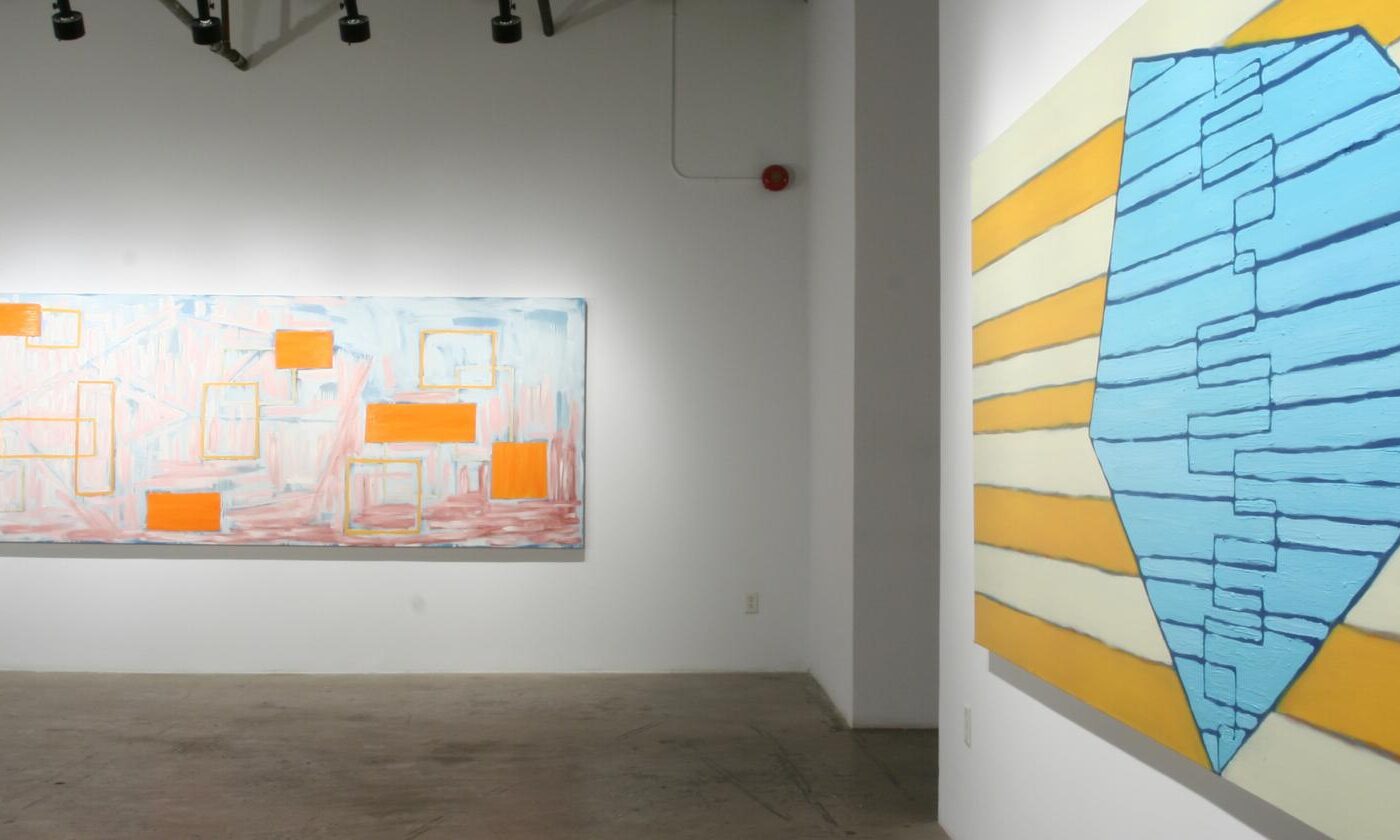
In a series of large paintings, the right-angled form is reiterated time and again, first as a line figure, blankly declarative and reduced, then as a pattern that calls to mind some of the geometric conventions for representing volume on a flat surface. Proliferating over and over, the shape – so fundamental to the perceptual world – becomes pluralized and strangely volatile, so as to suggest the unstable nature of perception itself. This precipitous fugue is deepened by the reappearance of the form in rough-hewn furniture, scattered on the floor between the paintings. Borrowing the now classic designs of Rietveld, the chairs and tables are constructed out of scrap wood, reprising the shape in an “anti-design” that both mocks and completes the allusions of the paintings. They are yet another referential circle – cubes within cubes within cubes – particularly as they occupy a gallery space, another archetypal white cube.
By underlining the uncertain status of a single form – is it a geometric abstraction? an element of space? a constructed volume? – Munk’s new body of work calls into question the safety of all assumptions. It reminds us that judgments, formal and otherwise, are always a negotiation of fields of tension, sometimes – antagonistically – between opposing poles, but more intriguingly, sometimes – with pleasure – between communicating vessels, and their overflow.
PduB
