Émile Riopel
S’il le faut, je me réduirai en cendres pour être sûr que le vent m’emporte
09.11–10.24.2026
Current
Artist
Samuel Lambert
A FAMILY RESEMBLANCE
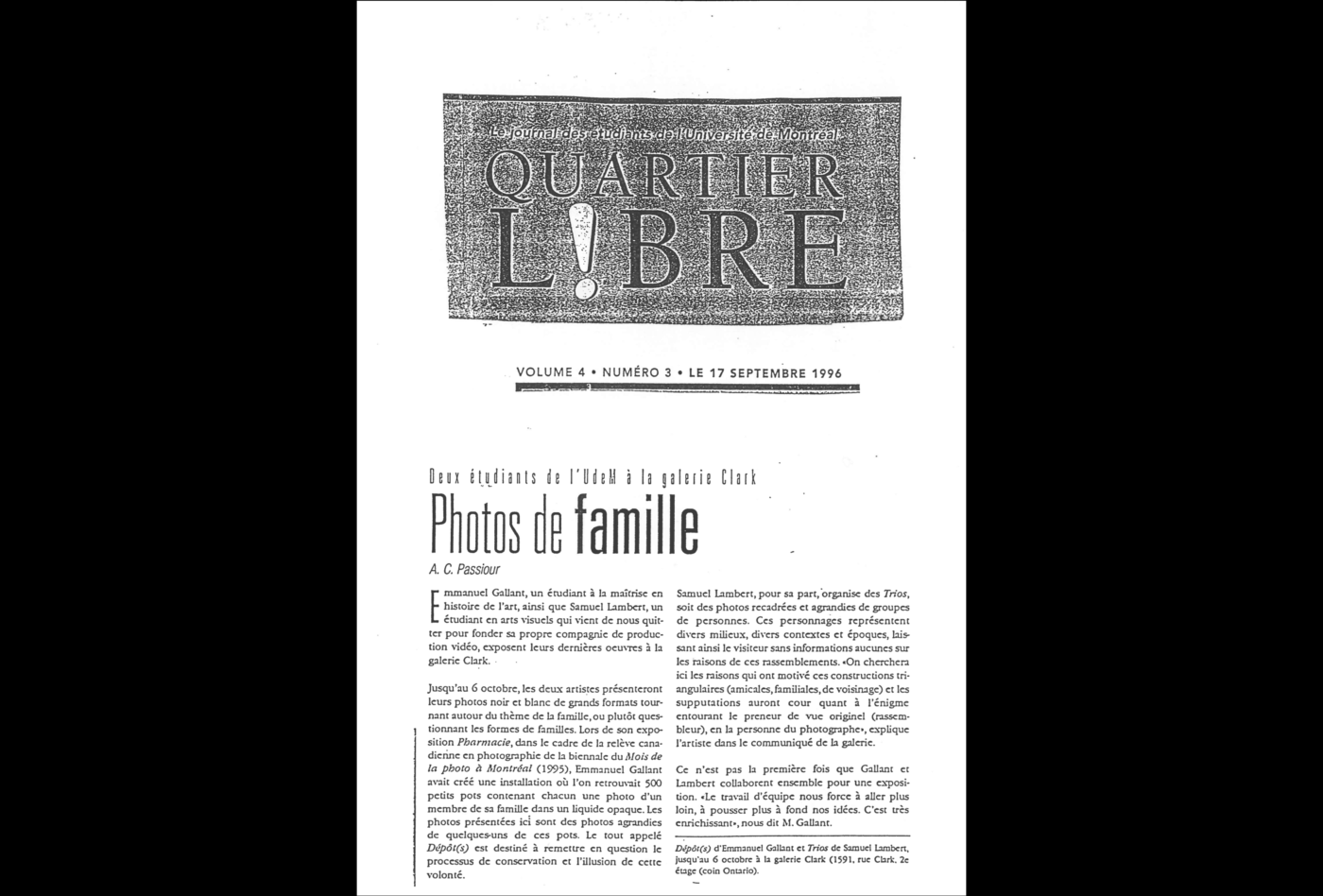
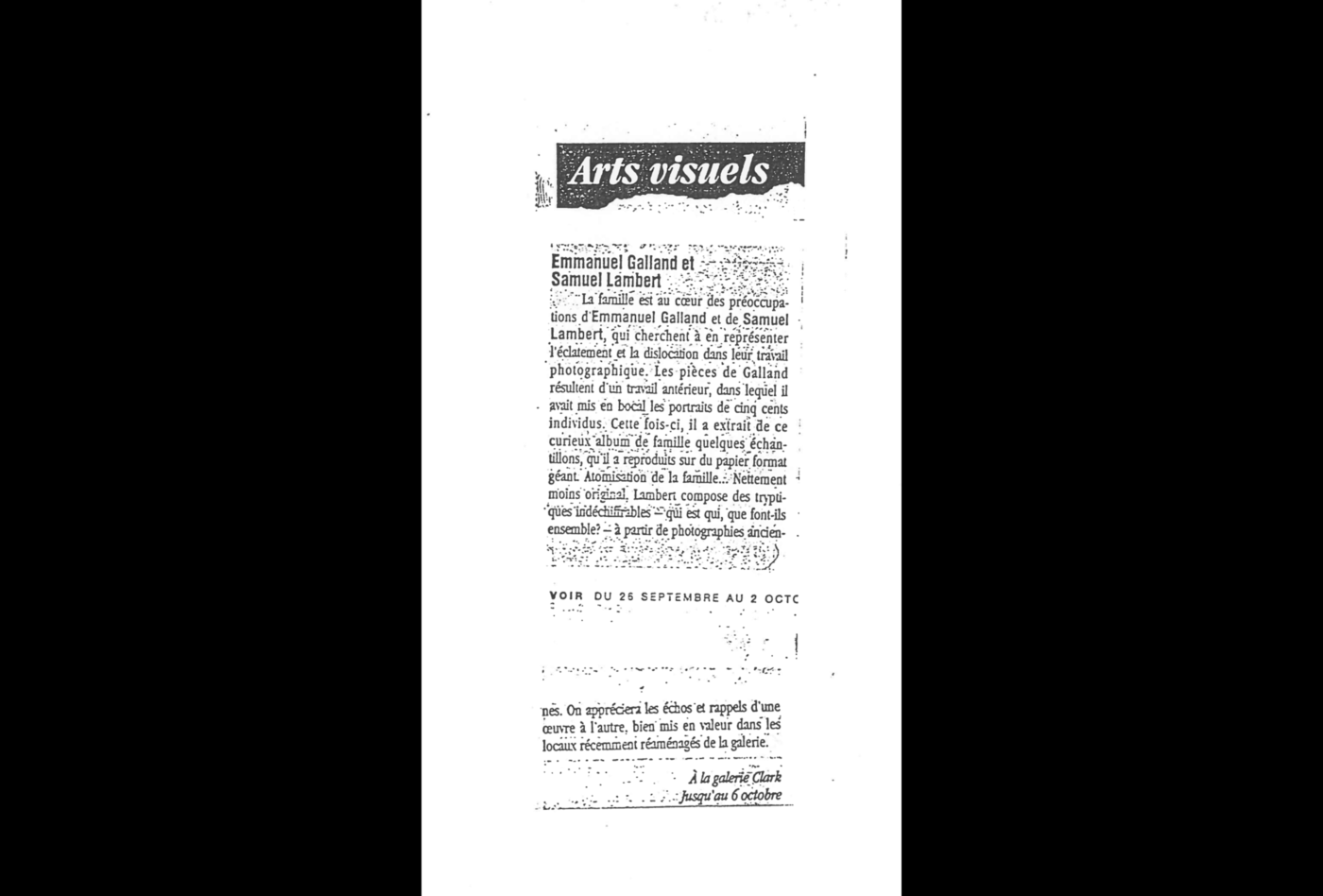
Emmanuel Galland and Samuel Lambert have been collaborating for several years on installation and video projects. Today, at Galerie Clark, they present a duo of large-format, strictly two-dimensional black-and-white photographs. This new body of work revolves around the theme of family—or rather, the forms that family takes. The photographs exhibited here share evident similarities, overlaps, and points of connection.
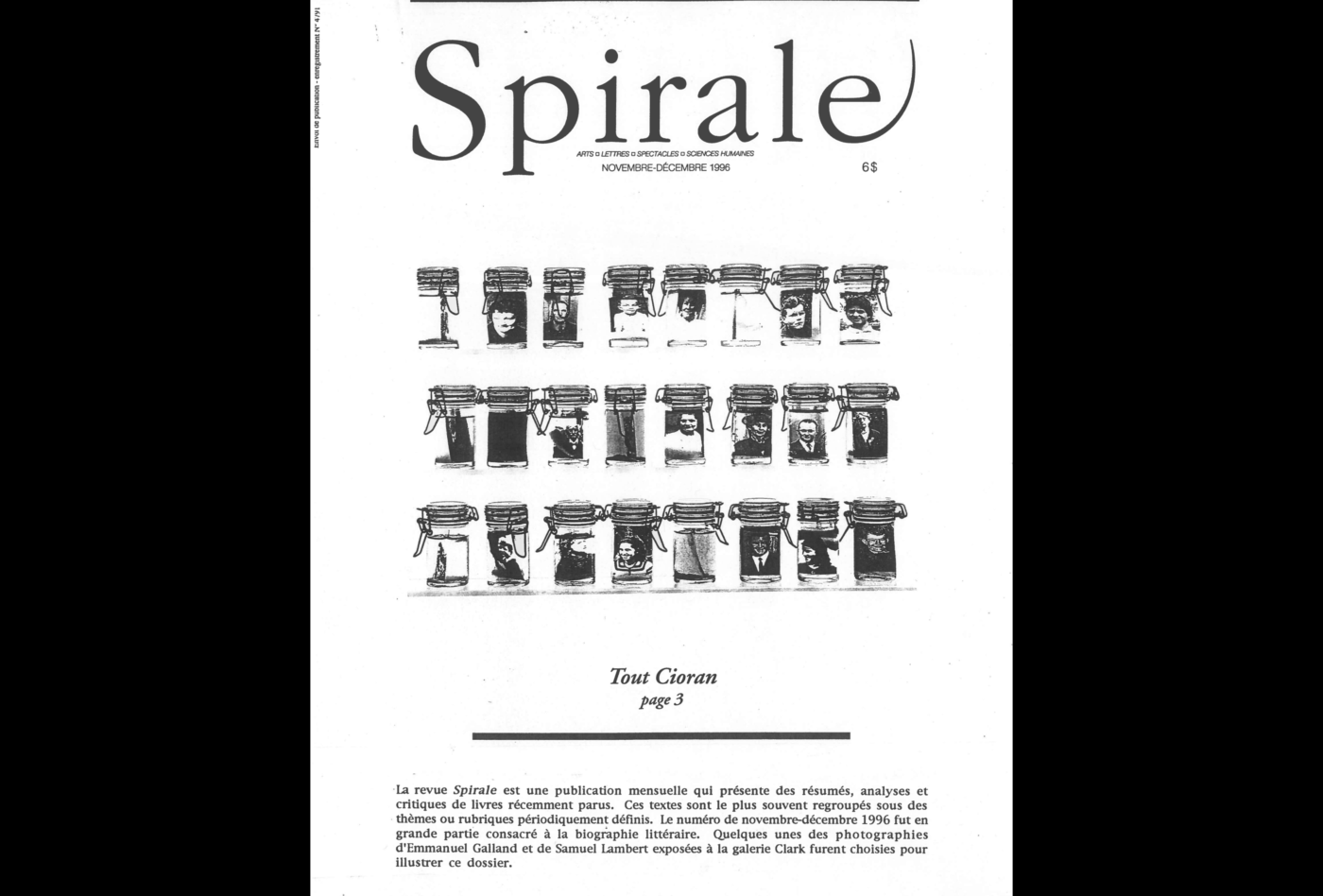
Emmanuel Galland focuses on the immediate nuclear family, including parents and grandparents (his own family). The bottles originate from an installation titled *Pharmacie*, first shown during the *Mois de la Photo* in the autumn of 1995 (*Du réel subjugué, Aspects de la relève canadienne*, Saidye Bronfman Centre for the Arts / Vox Populi). For this exhibition, he selected specific items from the roughly 500 jars containing his family album. The series presented here, *Dépôt(s)*, isolates individual jars and reproduces them in large format. Arranged in a row, the photographs appear to present a model of the parental structure—a model that seems almost obsolete given the family configurations we know today. The act of bottling—intended for preservation—is called into question by the hazy mist that obscures (or perhaps alters?) each portrait. The photograph, a freeze-frame in time, acknowledges the illusory nature of this attempt at preservation.
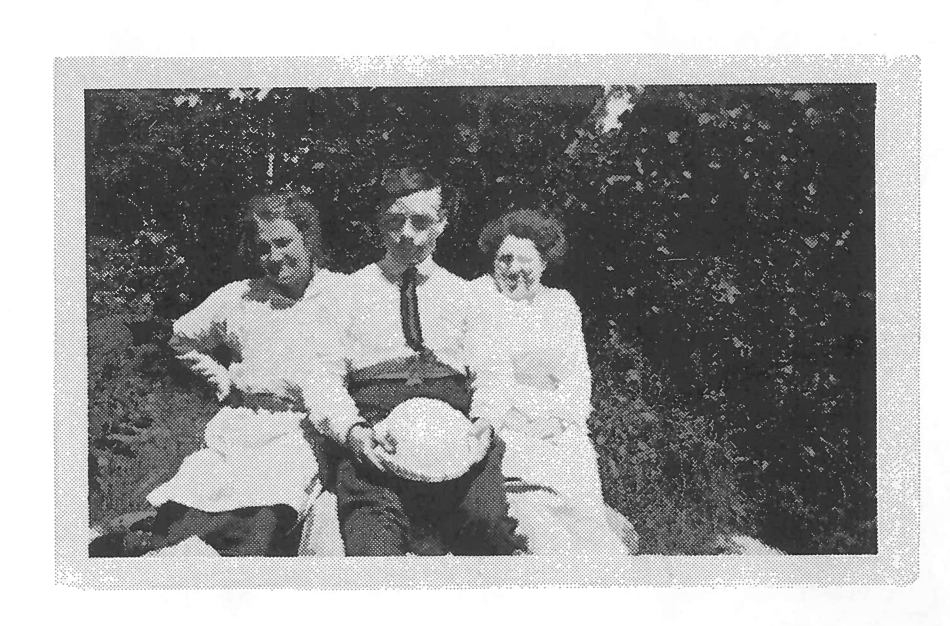
For his part, Samuel Lambert selects groups of people arranged in trios from found photographs spanning various eras. After cropping and enlarging the images, he displays them in series of three. Here, the artist presents us with diverse, reconstituted families. Formally, the alignment evokes a game of dice or a jumble of elements. Furthermore, the subjects—left in anonymity—offer no clues regarding the context of their gathering: was it ill-timed, accidental, based on affinity, circumstantial, or part of a celebration, a regular visit, or a rare occasion? In each instance, the central figure finds themselves inextricably linked—symptomatically so—either highlighted or nearly stifled by the close proximity of their impromptu companions. One might seek the reasons behind these triangular arrangements (whether based on friendship, family, or neighborhood ties) and speculate on the enigma surrounding the original image-maker—the photographer who brought the group together. By occupying that same space and position, today’s visitor leaves a fresh mark on the event.
Resembling advertising aesthetics—with formats akin to billboards—both bodies of work rely on the appropriation of private and collective photographic heritage. The interplay of loss (stemming from photographic enlargement and the ambiguity surrounding the subjects’ identities) and connection (groupings determined by the artist)—evoked here through various possible combinations—relates to concepts of personalization and depersonalization, as well as humanization and dehumanization.
This web of interconnections can be interpreted through several lenses: art and painting history (genre scenes and portraiture), the history of photography (both amateur and professional), and the history of fashion (which establishes the era); yet it can also be viewed through sociological (group formation), psychoanalytic (bonds and projections), or morphological (physical resemblances) perspectives.
The shared spirit driving these two young artists sheds light on the various levels of kinship—visual, thematic, and autobiographical—running through their respective works. It is up to the visitor to draw the connections and discern the distinctions.
A crowdfunding campaign for emerging artists.