Anne-Renée Hotte
Les rencontres ne savent pas qu’elles ont lieu
09.11–10.24.2026
Past
Artist
Azza El Siddique
In Ancient Egypt, Osiris was revered and feared as the judge of the dead and ruler of the underworld. Osiris was also the god associated with fertility and agriculture. His domain was earth and its endless cycles of growth and decay, bearing the responsibility for life and death.
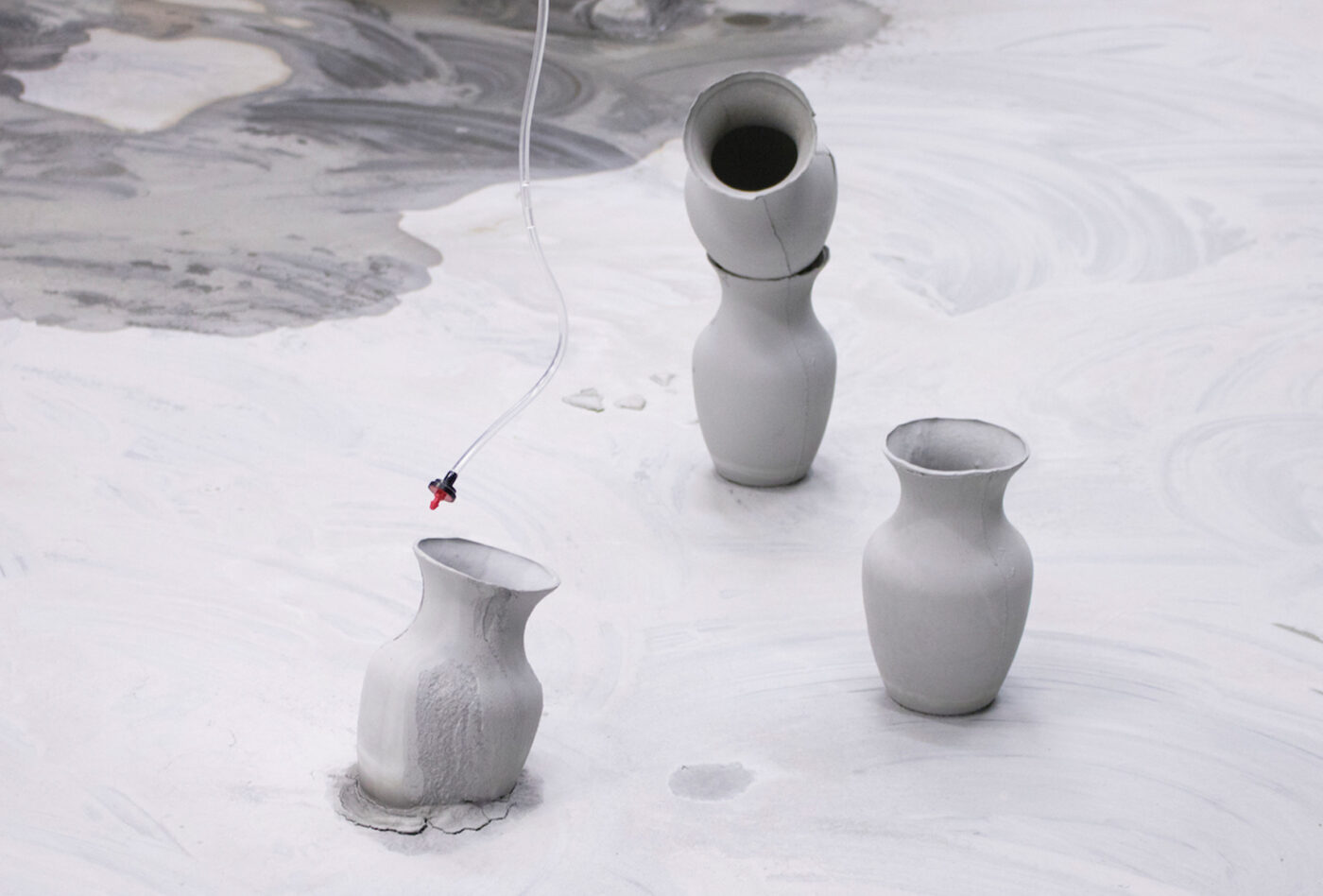
For her solo exhibition at Centre Clark, Azza El Siddique draws from the Book of Two Ways, a series of Ancient Egyptian graphic representations of the underworld contained in coffins from the necropolis of Deir El Bersha, dating back to 3100 BCE. It is the earliest example of the map of the underworld, Osiris’s dominion. In the middle of the gallery stands a large installation that recalls the shape of an excavation site. Its surface is covered in vessels that are also dispersed around the gallery floor. These seem to be melting into the ground, relinquishing their presence into the geometric structure in a testament to the entanglement of all things on earth. Or perhaps they are emerging as if they had just been dug out; the past resurfacing to carry a message from an ancient civilization.
El Siddique has maintained an interest in earth’s rich semiotic field – working to yield worthy considerations of our relationship to the ground below us: its connection to humanity’s past and its pledge as a final destination, but also its persistent sprouting of life and auspicious cultivation. The ground is sacred; it bears life and death in perpetual coexistence. It also offers a malleable material to give shape to ideas, vowing to bend itself to endless meaning. What better material to address the cycle of life than that of the knot that ties the beginning and end of existence.
Azza El Siddique’s centerpiece installation is accompanied by a projected text inspired by the Book of Two Ways that the artist heavily reworked – making it her own. The words flow smoothly across the room like a serene river. As the text traverses the gallery, one is reminded of an incessant news feed, of how world events are translated into words to be understood, digested, grieved.
Words have a liquid-like power. Like water, they can either destroy or nurture. No two voices are the same, no two handwriting styles are identical, yet language doesn’t solely exist at the individual level, it is also collective, shared. In El Siddique’s exhibition, language is presented as ambiguous. It exists first and foremost as a material. Like the scattered vessels, it surfaces and dissolves at once. However, while the clay objects remain undisturbed, language needs activation to operate its magic. In its perpetual regeneration, language remains resolutely fluid. In this way, solar evocation draws subtly on the tension between entropy and communication to expresses the unity of material and spiritual realms.
– Anaïs Castro
The artist would like to thank the Canada Council for the Arts.
A crowdfunding campaign for emerging artists.
