Émile Riopel
S’il le faut, je me réduirai en cendres pour être sûr que le vent m’emporte
09.11–10.24.2026
Current
Opening
Thursday May 7, 6pm
Artist
Nicolas Arthur Dufour
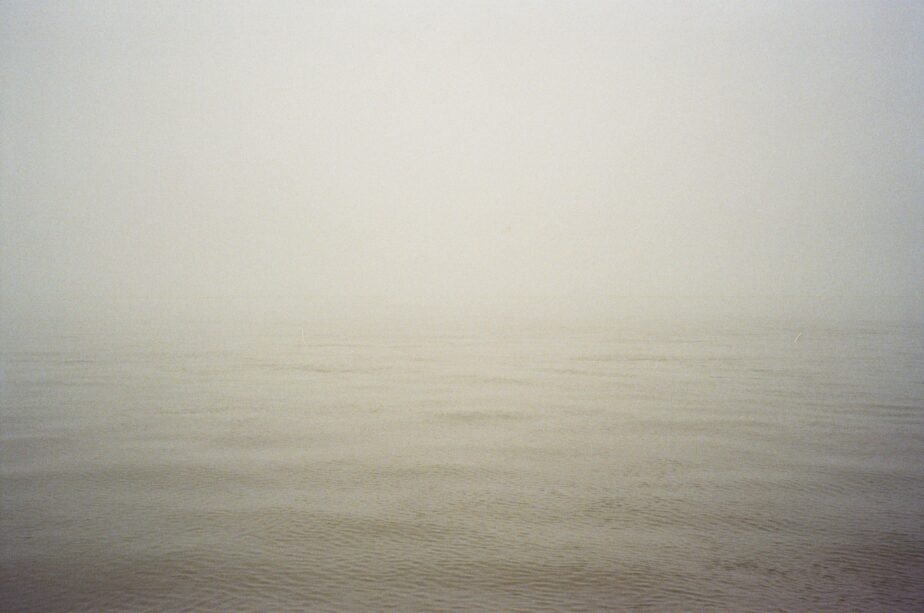
The Sirens: it would seem indeed that they sang, yet only in a manner that did not satisfy, that merely intimated the direction in which the true sources and the true felicity of song lay. Nevertheless, through their imperfect chants, which were but a song yet to come, they guided the navigator toward that space where singing would truly begin. They did not, therefore, deceive him; they genuinely led him toward the goal. But once that place was reached, what then occurred? What was that place? It was the place where nothing remained but to disappear, for music, in that region of source and origin, had itself vanished more completely than anywhere else in the world: a sea wherein, with ears closed, the living sank, and wherein the Sirens, as proof of their good will, were themselves one day compelled to disappear.
This sea is a desert, or rather: this sea became, gradually and yet at once, a desert. There lies the matrix of the myth I am constructing. There, the site of drowning, then of wandering. And finally, with no other possible end, that of utopia. I take up again the words of the legend: once the men had drowned, they returned to the depths of the Saint Lawrence, where they had once “strayed” while making their way, alongside other Sirens, toward the Red Sea. The Red Sea: both point of arrival and point of origin. I must therefore return to the Exodus of the Old Testament, when the Israelites, in order to leave Egypt, wandered for forty years in the desert. And when, pursued by Pharaoh’s army, they saw the sea open before them and close again upon the soldiers. We have lost all trace of the drowned, yet I am not deceived. Deprived of their earthly condition and of their full belonging to humanity, they must have learned to inhabit the sea. And the perilous songs they address to navigators are so many precarious attempts to re-establish contact at last.
I shall learn to swim so as to know your pleasure in dwelling within an abyss: these are my words, and those of the very terrestrial Cyclops, Polyphemus. It is also a song of love and of despair, a despair closely akin to ecstasy. Thus, like the Cyclops, my comrade, I learn to sing in order to learn to swim, in order to learn – for in truth we do nothing else – in order, finally, to learn to live.
— Nicolas Arthur Dufour
The title of the work (J’apprendrai à nager pour connaître votre plaisir d’habiter un abîme, which translates to I shall learn to swim so as to know your pleasure in dwelling within an abyss) is drawn from Theocritus’ Toute l’Idylle (3rd. century before J.C. / Edition of 1991, M. Chappaz & É. Genevay, trad). The italicized text is taken from Le livre à venir (1959) by Maurice Blanchot, with the exception of the passage concerning the Sirens of the Saint Lawrence, drawn from Légendes du Saint-Laurent II (1989) by Jean-Claude Dupont. The phrase apprendre à vivre enfin, translated as “to learn to live, at last” is borrowed from Spectres de Marx (1993) by Jacques Derrida.
Artist’s acknowledgements:
Thanks to Étienne Côté for his invaluable creative and technical assistance, which allowed me to bring this project to fruition. Thanks to my friends for their curiosity and their love.
A crowdfunding campaign for emerging artists.