Anne-Renée Hotte
Les rencontres ne savent pas qu’elles ont lieu
09.11–10.24.2026
Current
Opening
Friday May 9, 6pm
Discussion
Saturday May 10, 3pm
Artists
Curator: eunice bélidor
Stina Baudin
Paul Maheke
The term “valediction” refers to a farewell speech or a parting phrase. It’s an expression that concludes a letter. Meriting its own line between the body of the letter and the signature, the valediction is an ambient space tinged with affect that ranges from the dry and formal “Sincerely” to the ardently devoted “Love always.” The valediction describes the letter writer’s state of mind—the spirit in which the letter was written—and the way it should be retroactively read. And while the signature concludes the letter, the valediction, by naming an affect, sets up a waiting game of potential reciprocity. The valediction situates the author within a written space; a home port of intimacy. Upon reading the letter, the receiver finds themselves, in turn, in a sensitively worded space.
In the exhibition Valediction, on view at Centre CLARK, artists Stina Baudin and Paul Maheke weave affect. Their respective works bind stories and movements across time. With a free-thinking approach, Baudin and Maheke each employ data and networks to create intimate collective imaginaries and to critically examine identity, memory and traditional stories.
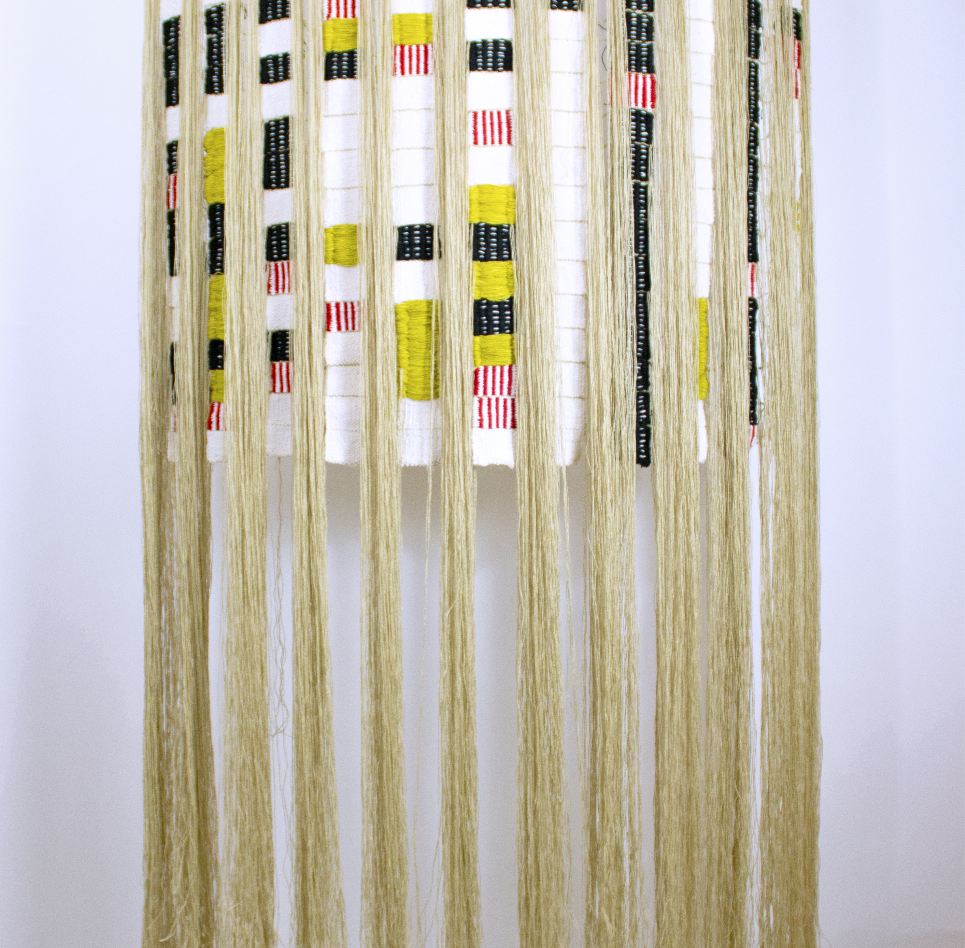
Stina Baudin’s sculpture Listen to your ancestors, they have all the answers (2023) represents internal models and coded messages. The idea behind this woven piece came to her at the height of the pandemic as she struggled with complex emotions over what was happening to Black people all over the world. The stories she encountered—which she compares to data—offered her little hope in the face of violence, loss, mental fragility and pain. Using her loom, Baudin began to calculate this information to find solutions to the problem of being a Black person in a systematically oppressive Matrix. In Data Studies 1.1 (2021-2024), Baudin uses statistical data to weave the migratory journeys of Black Caribbean-Canadians. In doing so, she explores ways of re-deconstructing Black archives—the interpretation of which is too often limited—to build spaces of Black cultural knowledge.
Paul Maheke is interested in how collective imaginations are built and how they establish the archetypes that define our relationship to otherness. His series of drawings titled Ancestral Musings (2023) bring up questions about history, visibility and representation. They explore the act of drawing as a process of emergence. Ancestral muses appear on the paper through fine, complex lines. Maheke, whose practice also includes dance and poetry, blends these elements in order to explore the experiential aspect of a body in space, as well as the way in which it can become an archive of personal history and experience.
Using different communication tools and embodied methods of archiving informational data that imbue their works with reciprocity, Stina Baudin and Paul Maheke, to whom we still and will always want to reply affectionately, sign the valediction of a deep and powerful missive.
— eunice bélidor, curator
A crowdfunding campaign for emerging artists.
